

It should not be a revolutionary thing for me to say that women are over-sexualised in the media all too often, (girls are over-sexualised, even), and no truer is this than in the music industry.
Popstars, instead of being idolised by teenage girls for their music, are frequently idealised by middle-aged men for their sex appeal.
Being cast as ‘Lolita’s’ (girls who are too young to have sex legally but who behave in sexually attractive ways), it’s all about the male gaze…
Dressing women up in school uniforms on music videos to appeal to the male gaze, selling stories about the sex lives of people who are barely of age (‘Has she lost her virginity yet? Has she had breast implants?), it’s so wrong.
It’s so wrong that so much pressure is placed on young women who are expected to live up to unrealistic expectations.
Being hounded by the press and turned into little more than objects of desire for men, they’re bound to get fed up and declare that they’ve had enough, but when they do? They’re labelled as ‘psychotic.’
We saw it with Demi Lavato who, in 2011, aged just eighteen, was sent to rehab and diagnosed with bipolar disorder.
In a recent interview (conducted in 2020), Demi Lavato stated that she had been misdiagnosed. In her own words, ‘bipolar was used as a convenient excuse for what was really happening.’
And we saw it with Miley Cyrus, too.
In 2010, at seventeen years old, Miley Cyrus’ management released ‘Can’t Be Tamed’, a song that describes her as crazy, sexy, wild, damaged, jagged and uncontrollable.
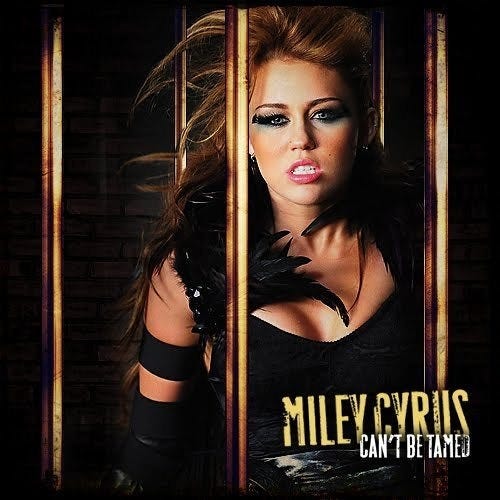
In the video, Miley is dressed as a wild animal in a large cage that rich people have paid to see. When she becomes uncontrollable and difficult to tame, however, the rich people become frightened of her and leave.
The most famous case study to reference here though is Britney Spears.
Something to link Britney, Miley, and Demi together?
They were all child stars, having been recruited by the Disney franchise as actors before becoming pop singers.
Britney started off as a child star. Getting cast on The Mickey Mouse Club at the age of just 11, she was catapulted into the limelight.
By 15 years old, she had signed a record deal.
By 17 years old, she was a sex symbol.
The music video for ‘…Baby One More Time’ (see above) was subject to much controversy surrounding the rationale for having Britney Spears sporting a catholic school girl’s uniform throughout.
Performative pedophilia.
Her short skirt, paired with knee-length socks, a white blouse rolled up to reveal her flesh, and pink bow-tied plaits were the epitome of sexual objectification.
Looking into the camera with an innocent, pure expression on her face, the music video sold the innocence of youth at the expense of selling Britney Spears’ own youth.

A few years later, t.A.T.u, a Russian pop group famed for their hit song, ‘All The Things You Said’ (2002), released their own version of the sexualisation of youth, where their music video featured two teenage girls making out with each other in school uniform.
Like Britney, they too started off as child stars.
The duo started out as part of the children’s group, ‘Neposedy’, at the age of just 9. By the age of 14, however, they auditioned for what would go on to become t.A.T.u, a pop group with “lesbian teenagers” as its image.
Again, another marketing tactic designed to appeal to the male gaze… Although this time, both misogynistic and homophobic, and the prime example of ‘queer baiting’ (‘a marketing technique involving intentional homoeroticism/LGBTQ+ themes intended to draw in an LGBTQ+ audience).
Serving to uphold the narrative that ‘lesbianism is for men’, even Yulia Volkova, the more ‘masculine’ presenting half of t.A.T.u (though still heterosexual, as per the queer baiting allegations) said in an interview:
Two girls together is not the same thing as the two men together. It seems to me that lesbians look aesthetically much nicer than two men holding their hands or kissing.
Sexualising sex and sexuality.
But why?
Why, following the release of the music video for ‘… Baby One More Time’ in 1998, did the sales of adult schoolgirl uniforms surge?
Infantilising, why are ponytails and school uniforms sexualised by men old enough to be the fathers of the girls they catcall when they’re walking home from school?
Why is pedophilia fetishised?
A social experiment that was doing the rounds on TikTok last year suggested that female workers in the service industry earn more tips from their customers, specifically older men if they are sporting pigtails.
Why are schoolboys not portrayed in such a hyper-sexualised way by heterosexual women but school girls are [hyper-sexualised] by heterosexual men?…

Upon googling ‘School Boy’, the first result shown is of a young boy in a school uniform. Upon googling ‘School Girl’ however, the first result is of a ‘Sexy School Girl Uniform Role Play Naughty Costume’ (see photo above).
For many men, the female high school uniform is more than just a reminder of the past. It is very much a part of their sexual desire in the present. The desire to control and to dominate. The desire to uphold the patriarchy where…
Men take, fighting for dominion over femininity, sexuality, and power. Women give.
Despite the fact that we are now living in a largely secular society, ‘back in the day’ when no sex before marriage was a rule that was implemented rather than scoffed at, women who were virgins were valued more.
This is why so much media attention was on Britney’s virginity (so weird) because virginity denotes innocence, we are told, and innocence denotes submission.
Girls are more attractive to men than women because they are easier to control and manipulate. They are easier to force into it.
When I was a teenage girl
I opened the CD in my bedroom
there was a poster folded up inside
to put up on my wall
it had Britney dressed in
a perfect white vest top
sat astride a chair
legs parted for the camera
camera zoomed onto her crotch.
– Hollie McNish.
While ‘… Baby One More Time’ was arguably Britney’s most famous, and most controversial song, in 2003, aged 22, she released ‘Everytime’ (see video below).
In the music video for Everytime, Britney was shown to die of an overdose in the bath and drown. Being pulled out of the bath and rushed to the hospital, paparazzi, even then, were depicted as scrambling around to take pictures of her dying body.
The constant hounding by the press at the expense of a young woman’s health was disgusting. What was this music video if not a cry for help?…
But did anyone help?
No.
A few years later, in 2007, aged 26, Britney had, what the media described as a ‘breakdown.’ The media were quick to report on the events that unfolded in this period, but not so quick to take accountability.
It made sense to me that Britney struggled so much. It’s not natural to have your every move scrutinised by the press, and your whole life pulled apart by people who don’t even know you.
Global media outlets, however, wavered their need to take personal responsibility for Britney’s declining health, and instead positioned her to be violent and psychotic, and a bad mother to her children.
Britney Spears quickly became the caricature of the ‘sexy but insane’ woman…
At the end of 2007, Britney’s father, Jamie, placed her under a ‘temporary conservatorship’ which lasted over thirteen years.
She was subsequently in and out of rehab during this time, sectioned several times, and placed on psychiatric medication as a result of her very public ‘breakdown.’
The hypersexualisation to pathologisation pipeline…

The most famous and commonly cited part of Britney’s ‘breakdown’ was when she shaved all her hair off. What a sad state of affairs it is when people were more concerned about this, her lack of hair and what it did for her ‘image’, than with the music video that she had released four years prior within which she had implied that she was suicidal.
In between a string of stints in rehab, Britney walked into a haircutting studio one night in 2007 and asked for all her hair to be shaved off.
The salon’s owner, however, refused, and so Britney took matters into her own hands by grabbing the clippers and giving herself a buzzcut, all the while paparazzi snapped photo after photo of her through the window.
Now of course, no one asked why Britney shaved all her hair off, for had they done so, then they would’ve been unable to sell their photos with the rhetoric of, ‘Look at this psycho.’
Instead, skip the context, that’s exactly what they did.
‘Look at this umbrella-smashing, hair-cutting psycho.’
In an interview some years later, however, Britney revealed that she hadn’t ‘lost the plot’, as the media depicted her to have done, but that shaving her hair was, in fact, a very thought-out decision, as she explains in her bestselling memoir, ‘The Woman in Me.’
I’d been eyeballed so much growing up. I’d been looked up and down and had people telling me what they thought of my body since I was a teenager. Shaving my head and acting out were my ways of pushing back.
Having been objectified and sexualised and made to question if she even wanted to be alive, this was Britney’s time to push back, and push back she certainly did.
Women are not psychotic for rallying against misogyny.
 Portfolio of Hope