
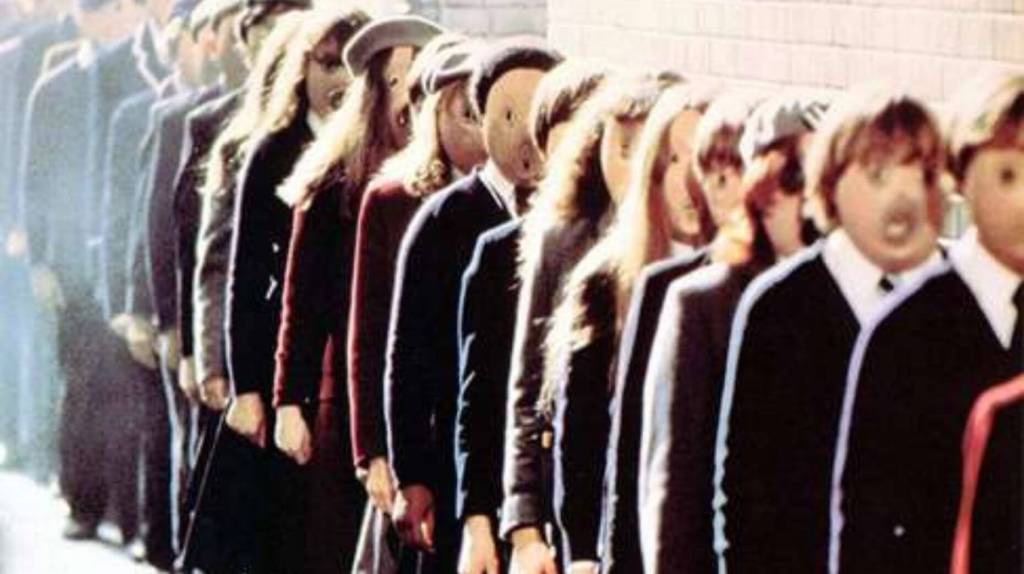
A creative concept like no other, Pink Floyd’s The Wall is arguably the most philosophical album, ‘we’re just two lost souls in a little fishbowl swimming around year after year’, ever produced.
It is not just music, but pure emotion expressed as a musical masterpiece.
Released in November 1979, The Wall’s themes relating to fascism were, although controversial, also incredibly timely given that a 5-year labour rule had just been overridden by Conservative MP Baroness Margaret Thatcher. This understandably put anxieties into the minds of a nation that was already becoming increasingly disillusioned with their lack of power and autonomy over their own lives.
The Wall’s heavy focus on the impact of government control and the corruption of power made it an album within which the nation could feel seen and heard.
It was the post-war era lyricised.
Alas, The Wall’s themes are arguably more pertinent today, in an era characterised by a resurgence in far-right politics, than ever before.
The prisoner who now stands before you was caught red-handed showing feelings. Showing feelings of an almost human nature. This will not do.
A deep dive into consumerism, authoritarianism, and fascism, the Wall is an analogy for how we separate ourselves from the basic humanity of others, with fascism being the ultimate example of this.
A person who is so consumed with hatred becomes the very thing that he hates.

History has shown that nearly all groups who build metaphorical walls of social righteousness inevitably seek to oppress those who believe differently. This is the case in Palestine, where Israel is performing ethnic cleansing (See also: genocide) against Gazans, as it was the case in the concentration camps of the mid-twentieth- century (1933–1945), where Nazi Germany sought to eradicate all Jewish people from the face of the earth.
Inspiration behind The Wall
The Nazi regime had great influence over the creation of The Wall, since Roger Waters (the mastermind behind most of the tracks) own father died fighting against them during the second world war.
The album tells the story from the perspective of Waters, ‘Pink’ who, following his father’s death, spirals into mental ill health, addiction, and isolation.
Such isolation is symbolised as a wall in the album (hence the name), where a metaphorical wall separates humans from humanity.
If I had my way, I’d have all of you shot!
A warning against making gods of men, ‘we don’t need no education, we don’t need no thought control’, Pink Floyd is vehemently anti-fascist. Yet Waters agitation against the System — the Military-Industrial-Espionage-Media-Tech-Energy oligarchy that rules the world through violence and exploitation — is the very reason that he has been the subject of consistent negative media coverage in recent years.
Make it make sense…
For supporting Gaza, ‘renowned British singer and former Pink Floyd lyricist, Roger Waters, has slammed Western countries for continuing to cast Israelis as victims, even though the residents of the Gaza Strip are being bombed by F-16s’, he was condemned by Israel who accused him of antisemitism. Because of this, Israeli lobbies tried to disrupt his Latin America tour.
But as Waters explained, ‘there is a Ministry of Truth. It’s called the mainstream media that does nothing but tell lies about what’s actually happening in the world, and we are persuaded by this propaganda to accept genocide.’
But hope isn’t lost, for as Waters goes on to say, ‘There is a moral compass out there somewhere, and there is a price to be paid for this evil in Gaza.’
The human soul cannot be destroyed.
I wanted to write about The Wall today because I fear that its themes are ones that we are returning to.
As Donald Trump returns to the White House, with Elon Musk on his arm like the cat that got the cream, one cannot help but worry that history is repeating itself.

We know what happens when nothing happens as the world turns increasingly right-wing and, in our privilege we look the other way, choosing to turn off the news on TV because it’s ‘too upsetting’…
In such times, hate gains momentum and, before we know it, we’re snowballing back to the fascism of the 1940s where marginalised groups are made to live in fear as hate crimes skyrocket, and we become just another case study (just another brick in the wall) to be written about in the history books of a nation that, in its complicity, welcomed the enemy with open arms.

We have seen it happening before. This is not some farfetched source of fearmongering; it is a real threat.
- Listen to The Wall.
- Watch Cabaret.
- Read 1984.
You go to the news for the news and to the poets for the truth.
We cannot trust the media, but we can trust art.

 Portfolio of Hope