

Ozempic was originally only available to purchase from and on behalf of people with a diagnosis of diabetes. Now, however, it is readily available for all to buy at the click of a button, thus cementing the link between Ozempic and eating disorders.
Online pharmacies mean that people don’t even need to see a doctor anymore to get prescription medication, they can simply fill out a form instead. This of course has the potential to be misused since it is easy to lie in responses to online forms.
Someone who can only get Ozempic with a BMI over 30 will simply state that their BMI is over 30 in order to get the medication they want.
- Superdrug
- Boots
- Lloyds
All of these high street pharmacies, and many more, are selling Ozempic (or its equivalent, Wegovy) online, a sign that the ‘Black Market’ isn’t so much black anymore as it is mainstream…
But what is Ozempic, exactly, and why is it being hailed as the ‘ultimate’ way to lose weight?
Ozempic: The Basic Facts
Ozempic increases the levels of hormones that are naturally produced by the stomach. This makes you feel full and not want to eat as much, with the food that you do eat taking longer to digest and therefore suppressing your hunger.
Instead of taking the usual 80–120 minutes (the length of time between you finishing a meal, your stomach emptying, and your brain receiving hormones telling you that you need an energy top-up), Ozempic slows down the movement of food through your stomach so that it takes longer for it to empty, therefore meaning that you feel fuller for longer, eat less, and subsequently lose weight.
The concerning thing about Ozempic, however, is the potential for it to get into the wrong hands since, as we discussed at the start of this article, it is so readily available to buy.
Ozempic and Eating Disorders: ‘Cure’ of or ‘Cause’ of?
‘You can’t engage in pop culture right now without being exposed to rhetoric around these medications,’ says Meredith Nisbet-Croes, a certified Eating Disorders Specialist Consultant at the Eating Recovery Center. ‘We haven’t seen a medication marketed this aggressively since Viagra.’*
*(Similarly to how Ozempic was originally developed to treat diabetes but is now being used for weight loss purposes, Viagra was originally developed to treat angina and high blood pressure, but was later used to treat erectile dysfunction).
When transformation videos and ‘what I eat in a days’ are being uploaded to TikTok in their masses under the term that now has over 1.2 billion views, ‘Ozempic’, the overriding societal message that thin bodies are ideal is emphasised, thus causing women in particular to place significant value on their bodies and weight…
But why?
The human body is not a trend, but a vessel for us to experience life through. Companies conjure up these ‘revolutionary’ products not because we need them to correct what is ‘wrong’ with us (there is nothing wrong with us), but because they know that the greatest profit to be made in the twenty-first century comes from a woman’s self-loathing. It’s why what is in one month is out the next month.
When did ‘I wish my bum was bigger’ replace ‘Does my bum look big in this?’
When did heroin chic go out and curves come in, only for it to go full 360 and heroin chic to come back in again?
We only have to blink for everything that we have been basing our value on to shift, and then we’re back to the start, back to trying to catch that which can never be caught- society’s acceptance of who we are for who we are, not for ‘I have just the thing that I can sell you to make you almost enough.’
‘Almost’, but not quite.
Never quite…
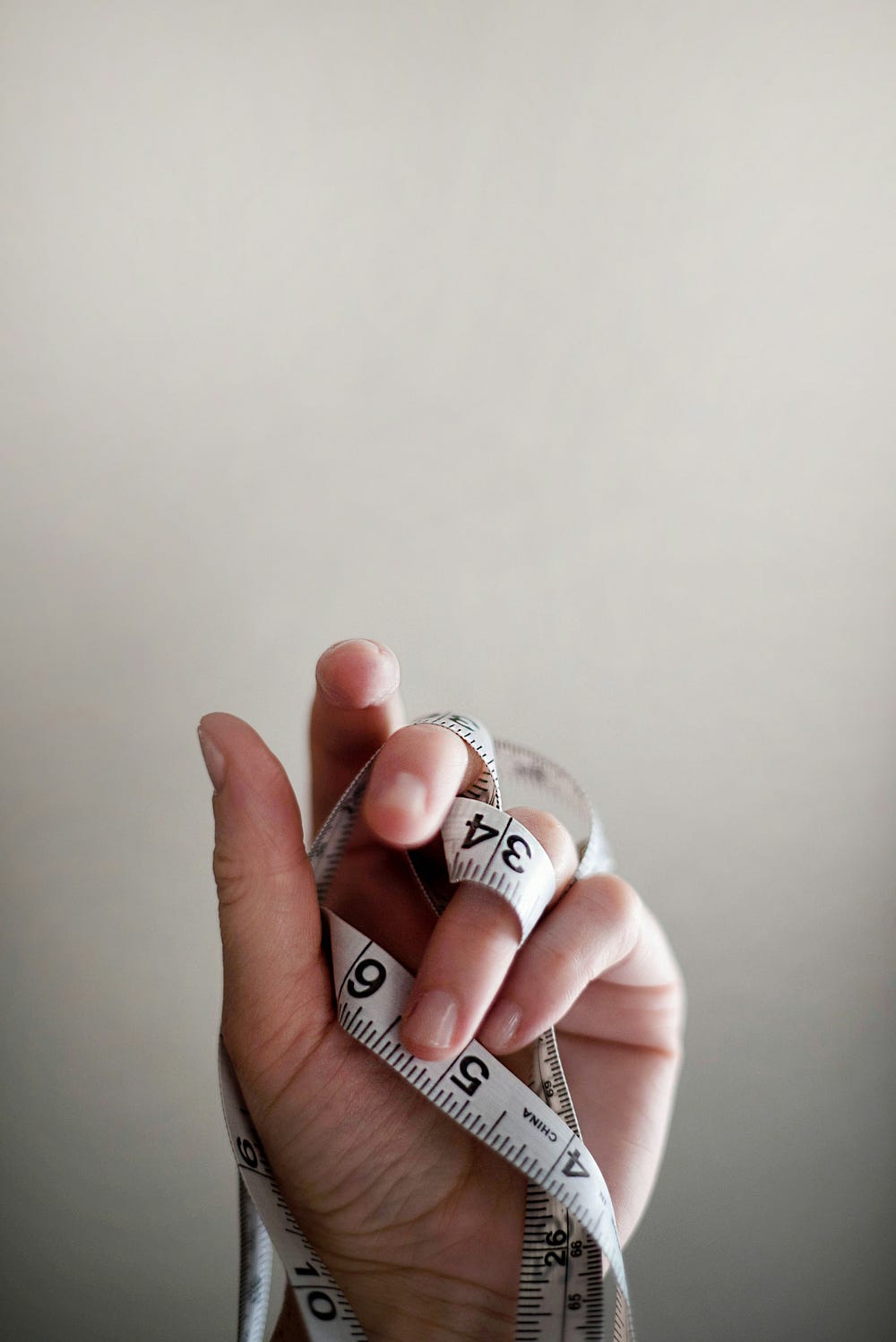
Most at risk of this perfectionist, ‘you need to be this size’ rhetoric is our young people whose consumption of social media provides the perfect storm for eating disorders to develop as a result.
Ozempic and Eating Disorders
Eating disorders are complex mental illnesses that can affect anyone, regardless of their gender, age, background, or ethnicity. They are not a ‘woman’s’ issue, but a human issue, and one that is, unfortunately, affecting more and more people in the UK.
While statistics highlight that 1 in 50 people in the UK suffer from an eating disorder, recent studies suggest that this figure may be underestimated. The charity Beat estimates that between 1.25 and 3.4 million people in the UK are affected by an eating disorder (Beat, 2024). Given the UK’s population of approximately 67 million, this suggests that up to 5% of the population may be affected.
The prevalence of eating disorders among young people in particular has seen a notable increase in recent years. The proportion of 11 to 16-year-olds diagnosed with an eating disorder, for example, rose from 0.5% in 2017 to 2.6% in 2023. Among 17 to 19-year-olds, rates increased from 0.8% to 12.5% over the same period (House of Commons Library, 2024).
It’s not a coincidence that the demographic that is becoming increasingly affected by eating disorders is also the demographic that is becoming increasingly affected by social media, where the marketing and promotion of Ozempic is at its most persistent.
When teenagers are already at the highest risk of struggling with low self-esteem, combined with the fact that they are also of the demographic who most frequently use social media (92% of adolescents are regular social media users), the constant marketing of Ozempic on the likes of TikTok will inevitably contribute to the exacerbation of eating disorders.
And this is what concerns me…
When eating disorders are already so dangerous, (one in four people die of the illness each year), Ozempic has the potential to not just ruin, but also end, lots of young lives…

Because food restriction can cause stomach issues including gastroparesis or ‘stomach paralysis’, a condition that causes the stomach to empty much more slowly than normal therefore making you feel full after barely eating, people with or in recovery from Anorexia are likely to struggle with their hunger cues, something which I experienced in my own journey with Anorexia. They might feel full very easily and struggle to eat as a result. If someone with or in recovery from Anorexia were to start using Ozempic, an appetite suppressant, the worry is, given their already very low appetite, that they would never eat…
My Experience
Having spent the best (worst) part of three years denying my hunger through food restriction, my hunger cues now are all messed up. This means that I can’t rely on intuition to make the decision of whether ‘to eat or not to eat’ (If I started eating when I was hungry then I would never eat, and if I stopped eating when I was full then I would never start). I must instead rely on structure.
It’s not that I never feel hungry, but rather that the signals in my brain exist in opposition to the signals in my mind.
I get the signals in my brain telling me that I’m hungry, I feel the rumbling in my stomach, but what I also feel is my stomach pressing against the fabric of my jeans, and the roll of flesh as I sit at my desk with six minutes to go until lunch, and it makes me not want to eat. Physically, I am hungry, but psychologically, I am full. And this is the problem that I have. What to trust, my brain or my mind? The two are supposed to be connected but when it comes to food, they are so far apart, at war with each other constantly, but still, I eat.
I eat because when I was hospitalised with Anorexia back in 2018, my admission taught me that regardless of whether you feel hungry or not, you must still feed yourself. Why? Because it’s a basic human need. Along with water, clothing, shelter, and sleep (Maslow, 1943), we all need food to survive.
And it is this, the fact that we all need food to survive, that makes Anorexia such a cruel illness…
Although eating disorders are a type of addiction, unlike every other addiction (drugs, alcohol, gambling, etc), my recovery is not dependent on me avoiding the trigger, but on me consuming it three times a day, every day, for the rest of my life.
It’s quite the battle when your ‘trigger’ is the very thing that you need to stay alive…
Recovery
Left untreated, eating disorders can cause serious long-term damage to an individual’s emotional, mental, and physical wellbeing. This is why having an awareness of the signs and symptoms is crucial.

The Signs
If you are questioning your eating habits, ask yourself the following:
- Do you experience feelings of guilt or shame when you eat?
- Are you preoccupied by thoughts of being thinner?
- Do you tend to eat in isolation or secret?
- Have others commented on your eating habits?
- Do you weigh yourself at least once a day?
- Do you skip meals in order to lose weight or to avoid gaining weight?
- Do you exercise more than once a day?
- Do your emotions affect your eating habits?
- Do you avoid close relationships or social activities?
- Do you vomit after meals?
If you said yes to more than one of the above, you might be struggling with disordered eating or an eating disorder. These behaviours and thoughts can develop gradually, often becoming ingrained before an individual recognises the severity of the issue. Identifying these patterns early and acknowledging the impact they have on your daily life is an important step toward seeking professional support and intervention.
Other common indicators of an eating disorder include:
- Preoccupation with weight and body shape
- Strict food habits or routines
- Self-induced vomiting or misuse of laxatives
- Excessive or compulsive exercise
- Avoidance of social situations involving food
- Mood fluctuations and behavioral changes
- Sleep disturbances
- Physical symptoms such as digestive issues, weight fluctuations, feeling cold, fatigued, and/or dizzy
If you or someone you know is exhibiting these signs, professional help should be sought promptly. Contacting a General Practitioner (GP) is the first step toward accessing support.
Don’t suffer in silence, and please please stay away from Ozempic. Whatever your size, your value is not determinable by a number, and a £195 injection will never buy you happiness.

When a woman shrinking herself to nothing is seemingly the only way to satiate a man’s greed, open your eyes.
It was never about you.
 Portfolio of Hope