

Gender performativity has skewed what it means to be a woman in today’s society.
When heterosexuality is the norm, and so much of our experience as women is shaped by our relationships with men, to be a lesbian and live a life where men are so decentered feels like something different, hence why I, like so many other queer kids, grew up thinking that there must be something ‘wrong’ with me because I didn’t fit the stereotype.
I don’t wear makeup. Or skirts. Or dresses. My identity is a barrage of confusion. I feel masc and I look masc (‘masc’ being short for masculine), but I am not a man. I don’t feel like a man, but nor do I feel like a woman. I am a lesbian.
A gender (for me) as much as a sexual orientation, lesbianism is my whole identity.
‘Lesbian’ as a gender is the lived experience of women who feel disconnected from society’s understanding of what it means to be a woman.
Gender Performativity
While biologically I am a woman, my gender is of the same importance to me as being biologically right-handed (i.e. Not important at all). This is why I go by any pronouns, she/he/they, because you cannot get wrong what is essentially nothing but a concept.
What is far more important than gender to me, and is a real signifier of my identity, is the term ‘lesbian’, and it’s why I do not relate to any gender in the ‘normal’, heterosexual world.
I don’t relate to man’s version of womanhood, as created by them and for them, where even the term ‘woman’, a combination of the words ‘wife’ and ‘man’, is rooted in the idea that men have dominion over women. For me, the term ‘woman’ only becomes meaningful in the context of lesbianism.
Am I a man? Am I a woman? I don’t feel like either. Yet in the queer, lesbian world, I do.
As white Americans just identify as ‘American’, yet black Americans typically identify as ‘black American’ (the white folks are the dominant group, so the white part is unspoken), I identify as a masc (/soft butch*) woman, unable to separate my sexual orientation from my gender because the two are so interconnected.
*Some people consider the term ‘masc’ to be more about expression (external) and consider the term ‘butch’ to be more about identity (internal), but ultimately, they can be used interchangeably to describe a more masculine presenting woman. It is, however, important to check someone’s preferences when it comes to labels, especially due to the negative associations that many people still have with the word ‘butch…’
The issue we have is that people believe the lies that society sells them surrounding gender, and what it means to be a man versus what it means to be a woman.
Alas, it hasn’t always been this way. Prior to the late 20th century, there was only one word, a universal term to describe everyone, and that word was ‘man’ (hence the term ‘mankind’). You could call anybody a man as long as they were human.
It wasn’t until after this that the gender-neutral term stopped being that, gender-neutral, translatable as human/person, and came to be attached exclusively to men. This coincided with feminist scholars such as Judith Butler making a differentiation between biological sex and what they dubbed ‘gender.’
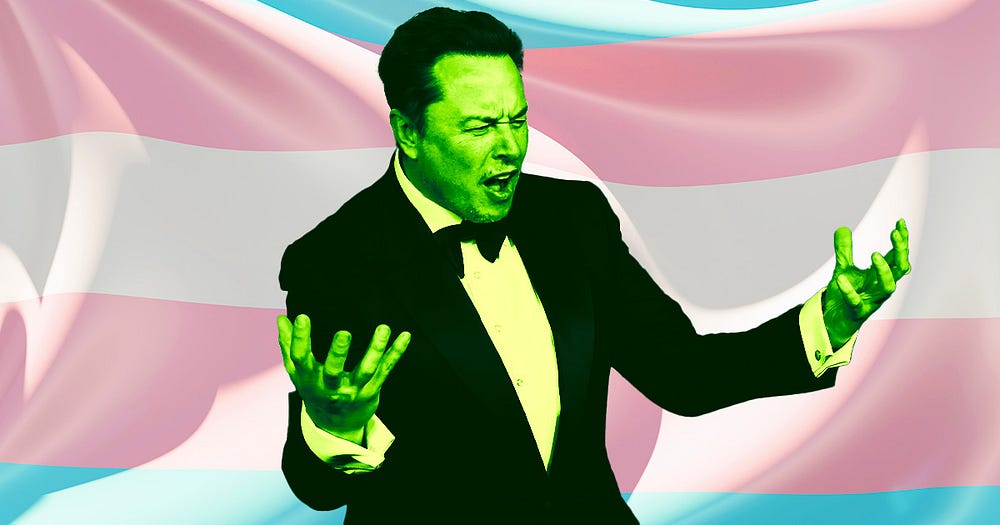
It is therefore unsurprising that the people who are the most transphobic, and who consider anything that goes outside the heteronormative binary as ‘woke bullshit’, are wealthy businessmen of the likes of Elon Musk and Donald Trump.
When the binary maintains the patriarchy, and the idea that gender can be different from biological sex is a feminist ‘theory’, it’s unsurprising why such people are so vehemently offended by it.
Similarly to how there was no distinction between female adults and male adults pre-twentieth century, there was also no distinction between male children and female children in the past.
In the same way that ‘man’ was the universal term for all adults, ‘girl’ was the universal term for all children. However, also like the term ‘man’, the term ‘girl’ no longer has the same meaning. No longer a universal term, it is now just another stereotype used to cause yet further division in society.
We use the word ‘girly’ to describe something stereotypically weak and delicate in contrast to the stereotype of masculinity which we deem to be ‘strong’ and ‘tough.’
The idea that toughness is the epitome of strength and that softness, as a man, is something to run away from feeds into toxic masculinity. ‘Boys should play with guns and soldiers; girls should play with princesses and fairies.’ Men who don’t live up to this heteronormative ideal (see also: toxicity) might subsequently struggle with knowing who they are as a result.
Similarly, women who don’t live up to their ideal of being nurturing, for example, or ‘soft’ are also likely to struggle. ‘If my favourite colour isn’t pink and I don’t like playing with dolls, am I really a girl?’
‘If I don’t like kissing boys but I do like kissing girls, am I really a girl?’…
Such stereotyping and division, whereby one feeds on the other, is an increasingly modern-day phenomenon when, as we have discovered, there used to be only gender-neutral terms. And, what’s more, it is the likes of Elon Musk who regard transgenderism as ‘woke bullshit’ that are to blame…
The fact is that if the world wasn’t set up to be so black and white then we wouldn’t be having this conversation because it wouldn’t matter how, if at all, someone chooses to identify, whether in terms of their gender, their sexuality, or both.
And so, the next time a bigot makes a ‘joke’ that in the good old days, man was man and woman was woman, you can correct them…
In the good old days?
 Portfolio of Hope