

Just before midnight on February 28th, 2023, a head-on collision occurred between a passenger train and a freight train travelling on the same track but in opposite directions between Athens and Thessaloniki in Greece. The result? 57 dead, many of them in their teens and twenties, and 85 injured. The question on everyone’s lips is… How did such an incident occur?
State negligence kills.
Railway workers’ unions have repeatedly denounced the lack of maintenance and non-implementation of modern security systems, whereby signalling systems are still reliant on manual operation despite chronic understaffing.
To put things into perspective, 2,000 railway staff have been fired since 2010, resulting in a workforce which currently stands at just 750 employees. Despite the government dubbing the crash as ‘human error’, it is this, as well as the privatisation that took place in 2017, that is the real cause of the crash.
Knowing this, thousands took to the streets in the aftermath of the collision to call the Greek government out for what transpired to be a double blow. Not only did the train crash due to state negligence, but it also caught fire following the collision for precisely the same reason.
While the reason for the fire hasn’t yet been proven, experts who analysed the footage suggested that one of the tanks on the freight train may have held illegal cargo, namely silicone oil.
It’s unsurprising that the Greek government wanted to pin the blame on someone, attributing the crash to ‘human error.’ Anything to shift the blame…
Several official reports have highlighted delays in the forensic examination of railway security footage of the crash. Hard drives from nine railway stations along the route, including the one covering the critical segment, were only handed over for analysis in November 2024, 21 months after the accident. And that’s only the files that remained… It has been alleged that 649,000 audio and video files from the official case file were excluded from investigations. These files reportedly contained critical data from railway communication logs and surveillance footage across Greece’s rail network.
If the government had nothing to hide, then why were they hiding?
Led by Maria Karystianou, because of the government’s unwillingness to publish all their evidence, some of the relatives of the victims filed lawsuits as a result, arguing that ‘the missing files contain evidence of negligence and systemic misconduct that has been deliberately kept out of court proceedings.’
So again, to pose the same question, if the government had nothing to hide, then why were they hiding?
Unfortunately, what happened in Greece in 2023 happens all over the world, every single day. While not every act of state negligence will end in the same tragic circumstances as the Tempi train crash (thank God), they will all lead to the same feelings of powerlessness and division between governments and their people, and this, in turn, will lead to protests.
‘When our cries fall on deaf ears, we scream.‘
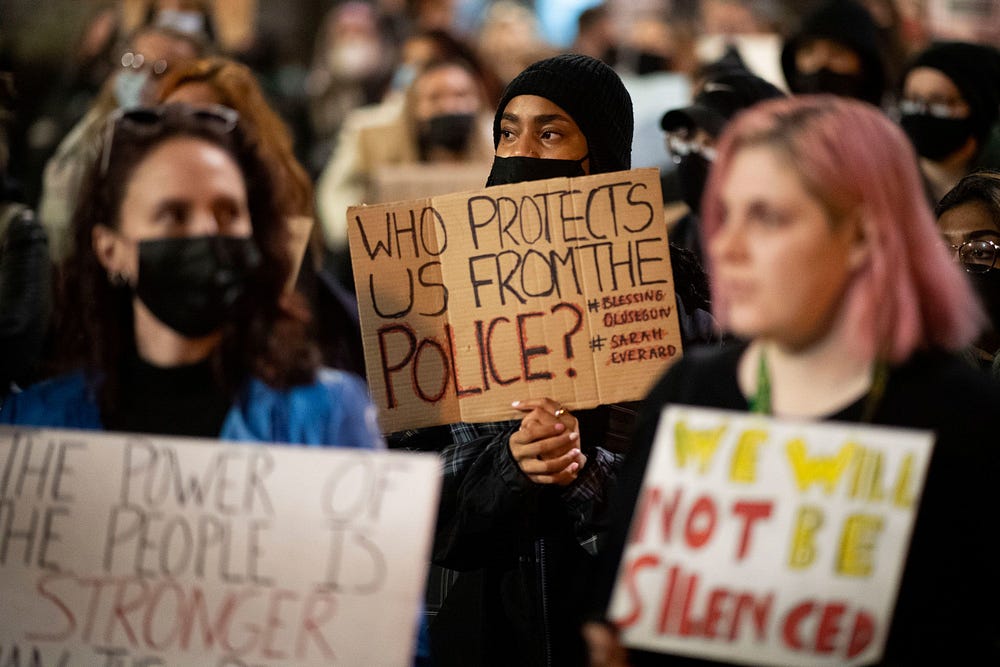
Looking closer to home, in March 2021, Britain was plunged into a state of shock and unrest following the murder of 33-year-old Sarah Everard at the hands of a serving metropolitan police officer, PC Wayne Couzens.
Ten days after the attack that cost Everard her life, a vigil took place at the Clapham bandstand where thousands gathered to pay their respects. The evening turned sour, however, when not even an hour after the gathering had begun, officers moved in to order people to leave. Arguments erupted and several people were subsequently arrested under the grounds of breaking COVID-19 restrictions, but not without backlash.
As women were put in handcuffs (ironic, given that this is exactly what happened to Sarah. She was handcuffed and ‘arrested’ for breaking lockdown rules), the crowd shouted, “Arrest your own.”
Countless people have since asked themselves why it took a young woman’s senseless death for the outpouring of indignation to finally burst forth.
An enquiry revealed how the police had repeatedly failed to spot warning signs about Couzens’ unsuitability to be an officer, including the fact that he had allegedly committed a very serious sexual assault against a child, described as barely in her teens, before his policing career began.
Kent Police also apologised for failing to properly investigate when Couzens was reported for indecent exposure, twice, just one month before Sarah’s murder. For this, PC Samantha Lee was sacked, however, the former officer later claimed that she was made a “scapegoat” for wider failings.
Sound familiar? A police officer blamed for the systemic failures of the met police // A station master blamed for the systemic failures of the Greek railway… It’s always a cover-up, the intersectionality of humanity proving that the struggles that we fight are never exclusive to one country. They are international.
No matter where we’re located in the world, the rise of the powerful at the expense of the people is a situation that we all endure.
Alas, prevention is better than cure.
Instead of focusing our efforts on looking for someone to blame following a disaster, we should, instead, be looking at ways to ensure that there is no disaster in the first place.
No more funding cuts or staff cuts to transport or the police. No more privatisation of public services. Only when the people in power use their power for something good, not merely as a form of coercion and control, will we, finally, be on our way to achieving the ultimate form of justice, the kind that benefits the many, not just the few… World peace.
 Portfolio of Hope