
Recently, I’ve been seeing increasing discourse on social media regarding trans people. Something which is unsurprising, considering that trans rights are being rolled back in many countries.
In the UK, for example, a supposed inclusive, ‘queer-friendly’ country, the Supreme Court, as of April 2025, defines man and woman only in relation to their biological sex. Based on this, the Equality and Human Rights Commission says that the use of public toilets should also be determined by biological sex.
Trans women (biological men) should not be permitted to use the women’s facilities, and trans men (biological women) should not be permitted to use the men’s facilities.
Why are we letting the safety of trans people be compromised for what is nothing other than a point-scoring exercise for desperate, power-hungry politicians?
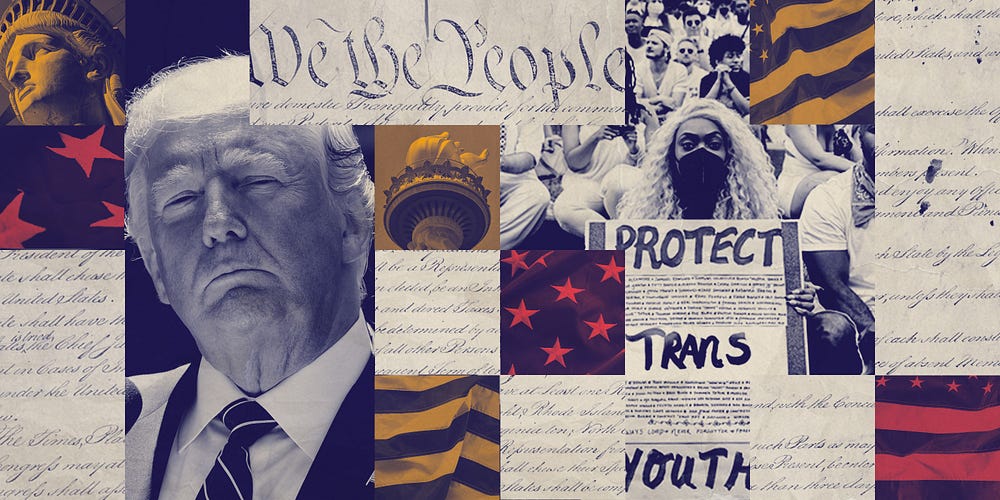
Another country that is supposed to be accepting of everyone, given its high-profile status in the Western world, is America. However, like the UK, the USA is becoming increasingly hostile towards trans people.
One of the first things that Donald Trump did when he returned to office in January 2025 was sign an executive order that rolled back trans and non-binary people’s rights.
During his inaugural address, Trump said: “As of today, it will henceforth be the official policy of the United States government that there are only two genders, male and female.”
When such transphobic narratives are being adopted by two of the most powerful countries in the world, the influence that this has on everyone is stark, hence the rhetoric that we are seeing doing the rounds on social media today.
The problem, however, is that the more people are told something, the more they will believe it. And if there isn’t an alternative rhetoric out there, then what hope do people have to realise the truth?
Only when people start speaking up for what they know to be right will attitudes towards trans people, or any marginalised group, for that matter, change.
You can’t change the narrative when the existing narrative is inaccessible.
As this article in the Guardian states, age and education are now the biggest dividers in UK politics, overtaking social class. This is why, during last year’s general election, just 5% of graduates voted for Reform UK compared with 25% of those with qualifications less than an A-level.
When nothing in life is without reason, there’s always a trigger behind why people act the way they act.
Cast your mind back to last year’s fatal stabbings in Southport and the riots that followed. They were awful, full of racism based on a misinformed and incorrect belief that the attacker was an illegal immigrant.
The footage of the riots aired on the news didn’t show people in suits throwing bricks through windows. What it showed was hotels housing asylum seekers being targeted by certain groups of people.

In response to the riots, the left rushed to social media to post about systemic racism and racial injustice.
However, when the people doing the rioting don’t understand such terms, how can they be expected to do better next time?
Is left-wing politics too exclusive to people who have had a certain level of education?
When it comes to issues that affect the most marginalised people in society, we can’t be particular about the terminology that we use. We must write and talk in a way that is accessible to the masses to close this trend that we are seeing towards right-wing politics.
Consider the word trans, for example. It’s the word attributed to the scapegoats of the moment, but what does it actually mean?
In order for society to move forward, society must first understand.
The word trans is short for transcending. Not fitting into a category. It is derived from Latin and means “across,” “on the far side of,” or “beyond”. In the context of transgender identity, being trans signifies a crossing or movement beyond the gender assigned at birth.
To simplify the meaning of trans even further, consider where you ‘transcend’ in your own life. You might not relate to transcending gender, but there will be areas of your life that you do relate to in this way.
Like eating food, for example.
Most of us don’t just eat sweet or savoury food, but a bit of each. Savoury for the main, sweet for the dessert. We therefore transcend being either a sweet or a savoury kind of person because we like both.
There are lots of examples that point to this sense of transcending something, and upon realising that, we can all come to understand that being transgender isn’t so alien at all.
Alas, we can only remove the prejudice when we remove the exclusivity.
As a lesbian, the algorithm shows me a lot of women-loving-women content on the likes of TikTok, and something that, disappointingly, I have been seeing a lot of recently, is lesbians denying that trans people can be lesbians. This comes from people who are ignorant of the different labels that exist in the trans community.
If we refer to our definition of trans again, a shortened word for transcending, to not fit into a category or to ‘move beyond’, there will be some trans people who feel like they move beyond even the category within which they assign themselves.

An important differentiation to make in all this discourse is that of trans mascs and trans men.
A “trans man” is a man who was assigned female at birth and now identifies as a man, whereas a “trans masc” is a broader term for individuals assigned female at birth who identify more with masculinity. This can include non-binary and gender-queer people who don’t feel as though they fit in either the male or female categories, but who lean more towards a masculine identity.
Being transmasculine teaches society that gender identity can be flexible with a spectrum of identities.
Transmasculine people don’t always need to be referred to as “he/him”. Some transmasculine people use “they/them”, “he/they”, and sometimes even “she/her” pronouns.
Even someone who undergoes a physical transition to look more masculine can do so without identifying as male. They might simply wish to appear masculine or male-passing to others. It is for this reason that transmasc lesbians exist.
Notice how easy that was to explain? I read a comment on a TikTok video asking how transmasc lesbians could exist when they are trans, so I wrote this article, knowing that not all questions about trans people are questions about their right to exist. Although that is the case in some situations, in many cases, people are simply asking because they genuinely don’t know and want to understand.
To reply to someone asking how a trans man can be a lesbian with loads of abuse is not only a missed opportunity to educate someone on what is a far underrepresented topic, but also a created opportunity for the occurrence of further aggravation and division between cis and trans communities.
Provided that people are willing to listen and open to learn, education and artivism are the only ways to heal a sick society.
 Portfolio of Hope