
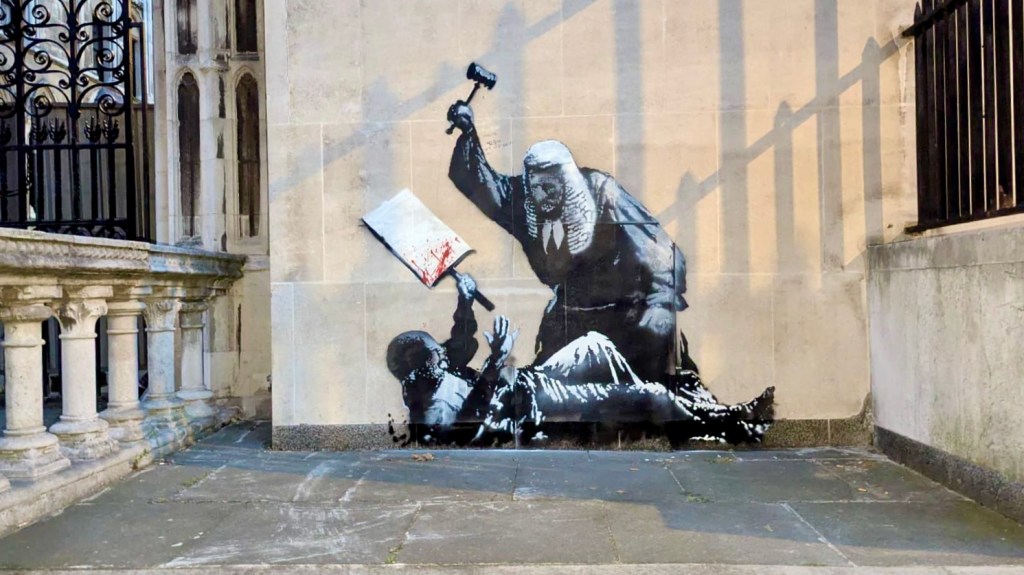
This week, a mural appeared on an external wall in the Royal Courts of Justice, London, depicting a protester holding a white picket sign spattered with red paint, meant to represent blood, and a judge towering over him.
The artist behind the mural was immediately obvious…
It was the work of Banksy.
Despite being worth millions and providing a new tourist hotspot, the mural was immediately covered up by Metropolitan Police officers.
If bias in the censorship of art wasn’t obvious before, it certainly is now.
The eradication of Banksy’s piece is not so much a cover-up of art so much as it is a cover-up of fascism, one could argue…
The artwork came two days after hundreds of demonstrators were arrested in central London for protesting the banning of Palestine Action as a terror group.
Banksy’s work of art on the walls of the Royal Courts of Justice powerfully depicts the brutality unleashed by Yvette Cooper on protesters by proscribing Palestine Action.
Silencing a work of art about silencing protest? Maybe it was a little too close to home, proving the lengths that the people in power will go to in order to hide their corruption.

The power of art
The attempted removal of Banksy’s most recent mural failed. There is still the perfect shadow of the art on the wall (see the image above), and, if anything, it’s now even more impactful than the original.
A source of hope, it reminds us of the power of art and its ability to leave a lasting impression on society.
Encouraging a national dialogue is something that underpins Banksy’s work…
Aimed as a form of cultural criticism (like the mural on the Royal Courts of Justice, many of Banksy’s pieces are critical of government policy, war, and capitalism), Banksy often targets established social and political agendas. He loves to make the elite the punchline.
The art world is the biggest joke. It’s a rest home of the overprivileged, the pretentious, and the weak.

Through graffiti, Banksy aims to start revolutions
The world became more* aware of Banksy in 2003 following his creation of ‘Love Is in the Air’, also known as the Flower Thrower. The graffiti was made on the 760km wall that separates Palestine from Israel (see above).
Banksy returned to the West Bank’s concrete wall in 2005, where he created a series of images depicting ideas about escape, including a girl floating away with a group of balloons, a boy painting a ladder, and two children with a bucket and spade, dreaming of a beach.
*Banksy has been creating murals/street art since the early 1990s, with his first known large wall mural being ‘The Mild Mild West’ in Bristol, but the turn of the 21st century is when he won international acclaim.
Banksy confirmed that he was behind the work in a statement that he released following its appearance. In it, he called Palestine the world’s ‘largest open prison.’
Over a decade later, he did something similar in his design of the Walled Off Hotel in Bethlehem, West Bank, Palestine. Established in 2017 and initially set out to only be a temporary exhibition, the hotel has since attracted nearly 140,000 visitors.

Never one to do things by halves, Banksy created Walled Off as a 10-room boutique hotel, a protest, and an art gallery all at once. Banksy hoped the venture could provide a boost in tourism and job opportunities to Bethlehem, which had suffered increasing Israeli control over travel.
Opening in 2017 was a significant choice.
2017 marks a hundred years since the British took control of Palestine and helped kick start a century of confusion and conflict, Banksy wrote on the hotel’s website.
Each room in Banksy’s hotel looks out onto the illegal concrete barrier, which separates Israel from the Palestinian territories. Banksy boasts it is “the worst view of any hotel in the world”.
It is intended to provoke productive political conversations within a more local region as well as globally.
Sparking much-needed conversations surrounding social justice and our need for more is something that Banksy will strive to do, at whatever cost.

In Bristol, where Banksy started out, the year 2006 saw the local council clamping down on street art. Banksy wanted to make a statement against this with a large piece directly opposite the main council building. However, this area had a lot of security, and he would not have been able to get away with it on his own.
Instead, he hired a legitimate scaffolding company to erect scaffolding up the wall he was targeting, claiming to be working for the council on a repair. They put up the scaffolding and sheeted it, so you could not see inside. As far as anyone was concerned, it was just normal maintenance.
Banksy worked overnight under the scaffolding to create the mural, and the scaffolding came down the next day, so by Monday morning, the council leaders could see it from their office windows. This placed them in a dilemma:
- They were clamping down on illegal street art and graffiti across the city.
- This was illegal street art.
- It was on a council building, right in the middle of town, and highly visible.
- It was a Banksy, and potentially worth millions.
19 years later? It’s still there…
Referring back to Banksy’s most recent mural on the Royal Courts of Justice, one cannot help but question why this was removed (well, attempted to be removed), whereas the mural that he created during a council clampdown on street art remained.
Is it the difference in subject matter? Unlike the recent mural, which is very politically charged, Banksy’s 2006 mural, named ‘Well Hung Lover’, is more… palatable?
What are the authorities trying to hide?
It’s easier to digest infidelity as opposed to inhumanity, is essentially the takeaway…
 Portfolio of Hope