
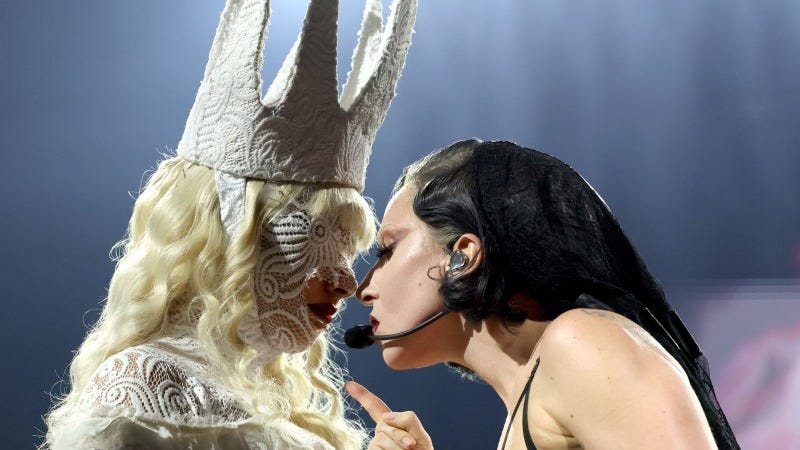
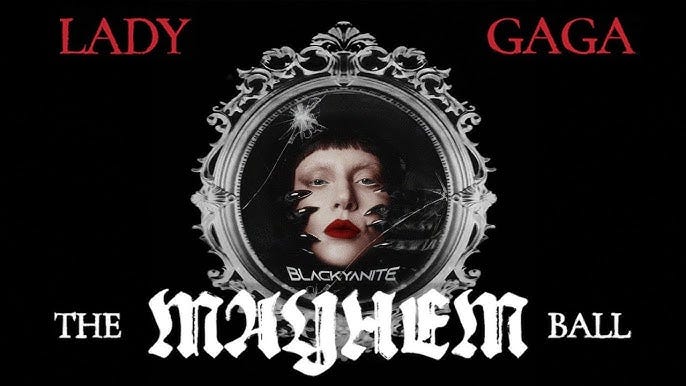
This week, on Tuesday, 07/10/25, my partner and I went to see Lady Gaga in Manchester, UK, as part of her world tour, the Mayhem Ball.
Before we had even set foot into the arena, the tone of the show was obvious. Outfits boasting unapologetic self-expression were the theme of the night.
Someone had recreated Gaga’s iconic ‘caution tape’ costume, adorning themselves in the sticky stuff.
Someone else had recreated her Coachella look, a white bodysuit with a large red cross painted on the front.
Several people had their faces painted to mirror the skeleton makeup from the Born This Way music video.
Whatever the fit, there was so much love woven into each seam, and everyone looked incredible. No one more so than Gaga herself, of course.
Gaga’s entrance to the stage was in a giant, 20-foot dress reminiscent of a two-story crimson birthday cake. The scale of it all posed a real ‘pinch me’ moment that would go on to last the duration of the 2.5-hour show…
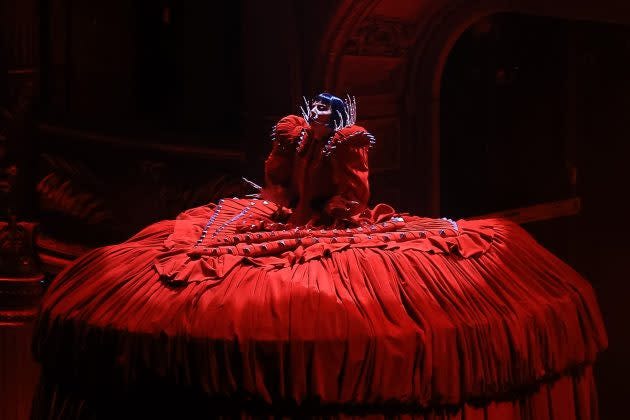
The Mayhem Ball truly is a concert like no other.
What Gaga has created in her career is something far deeper than ‘just’ music… Having been mentored by the great Marina Abramović in 2013, Gaga is a performance artist, blending music, dance, costumes, set, lighting, special effects, video, and poetry to offer the audience a glimpse into her mind.
From Gaga’s powerful vocals to her mind-blowing costumes and set design, the events of this tour are ones that I’m sure people will be retelling for many years to come.
Despite having no standing tickets on offer at this event, the atmosphere made it impossible not to stand… Everyone in the floor section was on their feet from entrance to exit, dancing and letting go.
I say ‘letting go’ because that’s what this concert felt like. An outlet. Escapism.
Coincidentally (or not), one of the songs on Gaga’s latest album, Abracadabra, echoes this sentiment. ‘The category is… Dance or die.’
There is only one option.
You must dance.
‘The world is a chaotic place,’ Gaga said in an interview with French journalist and YouTuber, Hugo Décrypte.
Have the courage to celebrate and dance during the mayhem.
And that we did, together…
Being in a crowd of people who have so much love is one of the most amazing experiences, for when you’ve spent your whole life feeling ‘other’, it provides the perfect antithesis.
We were among our people.
‘God and the gays.’
The show ended with Gaga singing ‘How Bad Do You Want Me’ (see below), having stripped all her extravagant makeup away. It was raw, and it was impactful. The perfect end to a perfect story.
What exactly was the ‘story’?
I’ve seen quite a few reviews online implying that, while Gaga’s performance at the Mayhem Ball was phenomenal, the ‘plot’ didn’t really make sense.
Dig deeper, however, and you will see that it does.
Gaga has created a philosophical masterpiece, taking great influence from Friedrich Nietzsche (1844–1900).

Lady Gaga’s Mayhem Ball embodies Nietzsche’s philosophy of duality, merging Apollonian order and Dionysian chaos to reveal that true art — and true self — can only exist through the harmony of opposing forces.
From the opera, “Welcome to the opera house. This is my house”, to the ‘characters’, the Mistress of Mayhem and Gaga, and the album cover, a shattered mirror reflecting two faces (see below), the influence that Nietzsche’s findings on the duality of art have had on Gaga’s creative direction is stark.
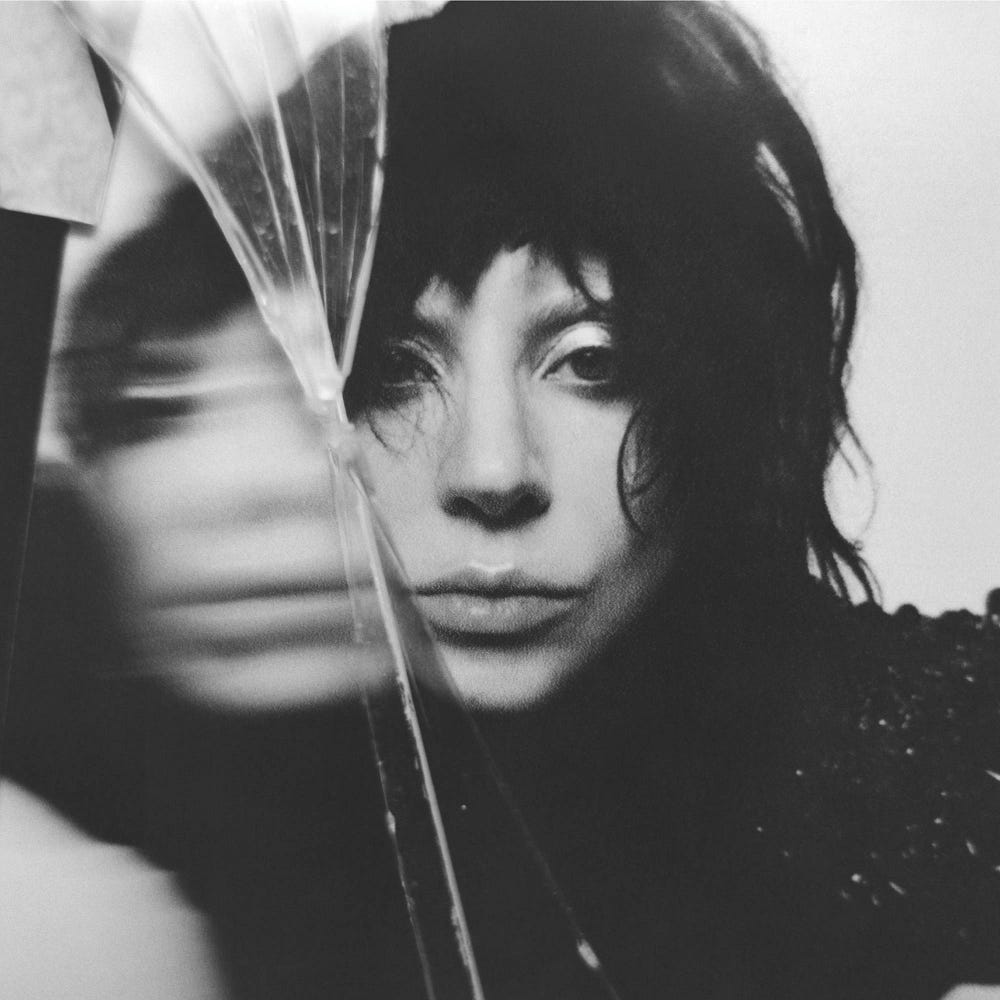
Art is ‘a careful tension between two opposing forces’, Nietzsche wrote in his first major work, The Birth of Tragedy (1872). These forces come from the gods whom the Greeks created to cope with the chaos (to use another word, mayhem) of the world.
Humanity is alone, and facing the whims of fate, the forces of nature, and its own helplessness.
Apollo and Dionysus were the names of the Gods created by the Greeks. They had human traits and were just as moral as they were immoral, going after virtue as much as they sinned.
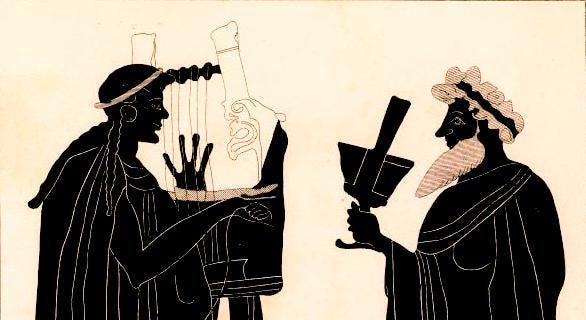
From Apollo comes Apollonian, a term that Nietzsche used to describe a dream state that we understand as our reality. In it, the emphasis is on rationality, logical thinking, self-control, and individuality.
The latter is where the issues arise. There can never be a true depiction of reality in a place where others get left behind. It will always be flawed.
In contrast is Dionysian, a force that comes from the god Dionysus. It represents intoxication and a journey of self-discovery. The ‘discovery’ is always the same — one reaches an ecstatic state, in Gaga’s case, fame, before arriving at a higher realisation.
The Greek tragedy: a fusion of the Apollonian and the Dionysian.
Art, according to Nietzsche, derives its continuous development from the duality of Apollonian and Dionysian, of which there cannot be one without the other.
In the context of Lady Gaga, the Dionysian challenges her, creating ‘dance or die’ situations that push her to confront her fears and insecurities. If it weren’t for the Apollonian bringing clarity in these situations, Gaga would lose herself to a persona.
By uniting the two opposing forces, however, Apollonian and Dionysian, Gaga can express both the light and the dark aspects of her existence.
The two forces might fight, but ultimately, it will all work out. In the end, they will recognise the existence of each other “… and lo! Apollo could not live without Dionysus!”.
This mirrors the end of the Mayhem Ball.

Throughout the show, Gaga, the emotional, thoughtful persona, is seen fighting the Dionysian character, the Mistress of Mayhem. This is a persona who is obsessed with fame, money, and popularity. They feature in songs such as “Paparazzi and Perfect Celebrity”, and are heavily influenced by the ego, wearing extravagant and outrageous costumes that hide their face to deliberately put up a physical barrier between themselves and everyone else.
Although much of the show sees these two personas fighting, the ending sees them coming together, finally.
What is significant about this is that it signifies that we all have these two opposing forces within us. We can try to squash one down in favour of another, but the only way forward is to grant permission for both to exist.
Which is something that Gaga has spoken about in interviews before.
When being pressed with the question of fame, such as ‘how do you deal with it?’, Gaga explains that while she used to struggle, now, she is pretty good at it. Why? Because instead of treating Lady Gaga as a persona separate from Stefanie, now she recognises that they are both a part of her.
And her and I will find a way to live as duelling twins.
It’s important to note here that the influence of Nietzsche’s philosophy spans way beyond Gaga’s latest album.
In her 2011 album, Born This Way, there is one track in particular, “Marry the Night”, that shows how Nietzsche’s influence on Gaga has been a longstanding one. The title itself can be perceived to be a nod to the Dionysian/the darkness.
In the almost 14-minute-long music video (see above), Gaga finds herself in what appears to be a mental hospital. Despite being in the situation that she’s in, Gaga’s thoughts centre around what designer labels are adorning her body.
She enters a dreamlike state, which is perhaps Apollonian, but it’s not reality. It’s an illusion.
The nurses wear next season Calvin Klein, and wear their surgical caps at a tilt on their heads as though they’re berets, “because I think it’s romantic.”
Gaga’s out of it, doing her best to swap reality for fantasy. Even when she’s being spoken to by a doctor, all she can think about is fame. “I’m going to make it. I’m gonna be a star.”
The doctor leaves the room, and Gaga puts a surgical cap on, at a tilt, of course, and starts to dance.
Gaga chooses dancing over dying every time.
In the very last scene, there’s a red lady with a large hat hiding her face, ascending above the flames.

The Mistress of Mayhem has evidently been around for many years, as has Gaga’s message, ‘dance or die.’
The theme of dance is a recurring one (“Just Dance”, “Dance in the Dark”), but what is bigger than that is the theme of duality. The sense of there always being two forces at play.
Death or love.
Dance or die (“Abracadabra”, 2025).
This sense of duality is evident in all three of Gaga’s manifestos.
There is, of course, the Manifesto of Mayhem (see above), which I have already touched upon: ‘Her and I will find a way to live as duelling twins’, but there is also the Manifesto of Mother Monster, which was released with Gaga’s third album, Born This Way, in 2011. In it, Gaga writes:
And as she herself split into two, rotating in agony between two ultimate forces, the pendulum of choice began its dance. It seems easy, you imagine, to gravitate instantly and unwaveringly towards good, but, she wondered, ‘How can I protect something so perfect without evil?’
She can’t.
Nietzsche’s philosophy surrounding duality and the need for both forces to exist in order to create art is evident here.
I find it so incredible how much has been going on in the background with Lady Gaga. She truly is a creative genius. To be able to tie all her albums, of which they span seventeen years, together with a universal thread that is so subtle that only a deep dive such as this reveals truly is a work of magic.
The artistry behind it all is mind-blowing.
Talented, brilliant, incredible, amazing, show-stopping, spectacular, never the same, totally unique, completely not ever been done before, unafraid to reference or not reference, put it in a blender, shit on it, vomit on it, eat it, give birth to it…
Lady Gaga, everyone.
What a phenomenal woman.
 Portfolio of Hope