

Religion has been depicted in art for millennia, taking off most notably during the Renaissance period, dated between the 14th to 17th centuries.
In a bid to transition away from the Middle Ages and foster a renewal of Christian thought, the Renaissance period saw religious themes becoming deeply embedded in art and architecture. Many religious figureheads began to commission famous artists to paint murals for their establishments as part of this move to modernity. This is how one of the most famous pieces of artwork of all time, The Last Supper, came to be.

The Last Supper (see above) was commissioned by Ludovico Sforza, the Duke of Milan, who wanted to include the mural as part of a larger renovation of the Santa Maria Delle Grazie monastery. Similarly, The Creation of Adam was also commissioned, though this time by Pope Julius II, who wanted to use it to cover the ceiling of the Sistine Chapel in the Vatican.
Why were religious figureheads so eager to commission artists to create for them?
Because the themes of religion are rooted in concepts that are difficult to put into words, art offers a unique language, using symbolism, iconography, and aesthetics, to explain the unexplainable. This is why, upon combining art and religion, the results are so breathtaking.

While there have been many examples of art being used to promote religion, as in the case of The Last Supper and the Creation of Adam, there have also been many pieces of ‘religious’ art made in satirical ways as a means to question its authority.
One artist who sought to encourage people to reimagine religion was the American photographer, Robert Mapplethorpe (1946 – 1989).
Having been brought up catholic, despite no longer being religious, Christian imagery inspired much of Mapplethorpe’s work. Religious themes of punishment and transcendence were commonplace in many of his well-known photographs, particularly those involving homoerotic or sadomasochistic themes. Creating a delicate balance between the painful and ecstatic, Mapplethorpe often framed his images in a way that suggested a struggle between these two concepts.

Another artist who has reframed what most people consider ‘religious art’ is the American photographer and visual artist, Andres Serrano.
Like Mapplethorpe, Serrano uses religious imagery in his work, something which has similarly earned him a reputation as being controversial.
Serrano’s most famous piece, Piss Christ (see image below), was created in 1987. Its creation saw Serrano putting a plastic crucifix into a glass of his own urine.
Well aware of the Catholic obsession with the body (that of Christ and those of sinners), Serrano sought to confront the discomfort most people feel with their own bodies and their products, and the prevailing cultural disgust for bodily fluids.
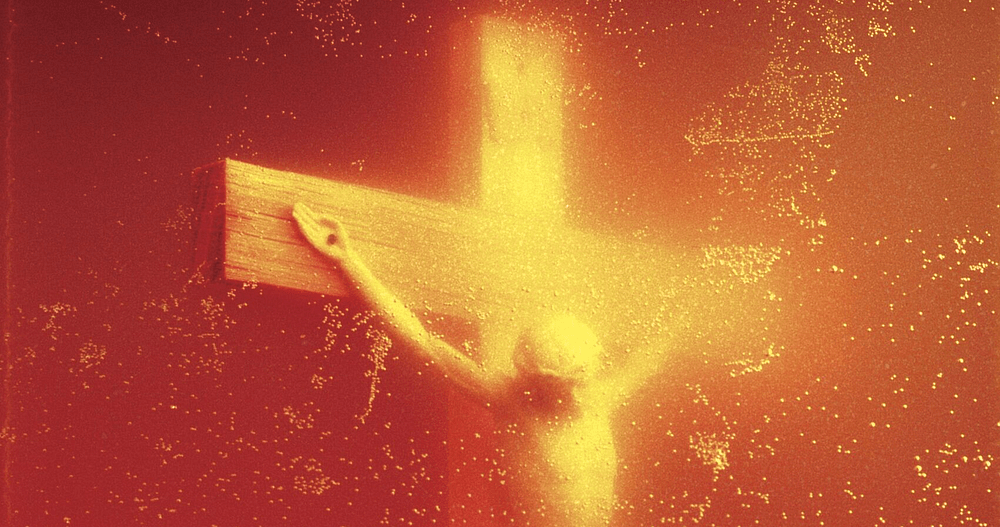
Over the years, many people have found Serrano’s art offensive. In 2011, French Catholic fundamentalists attacked and destroyed Piss Christ with hammers as part of an ‘anti-blasphemy’ campaign. Serrano’s photograph of a meditating nun was also damaged in the attack. What the attackers failed to understand, however, was that Serrano himself is a practicing catholic. Piss Christ, therefore, wasn’t created to undermine religion, but rather, to do the opposite – to take a stance against the misuse of religion and criticise the commercialisation of sacred imagery.
Crucifixion is a very ugly and painful way to die, but we see the crucifix as a very aestheticized object which has lost its meaning.
In a sense, then, Piss Christ is simply Serrano’s way of returning the story of Jesus back to something like its physical reality.

What is evident from my research is that artists at large find great influence in religion. Roughly one-third of the paintings in the National Gallery’s collection of Western European art are of religious subjects. Furthermore, using myself as an example, I am not religious, yet my poetry often touches upon themes of religion.
To quote Andres Serrano, the photographer behind ‘Piss Christ’:
For me, art is a moral and spiritual obligation that cuts across all manner of pretence and speaks directly to the soul.
Serrano’s belief is in line with Buddhist philosophy, too, which suggests that the imagination involved in the process of creating or looking at art, or listening to music, is a type of meditation, and, in turn, a very important part of the journey towards enlightenment.

What do art and religion have in common that has made them such a fitting pairing throughout the years?
There’s a reason why cathedrals are adorned with art, commissioned murals covering ceilings and walls, as there’s a reason why hymns are sung during service, and poetry is read, and it’s because art has the unparalleled capacity to create a sense of unity and shared experience within us all.
This is why, throughout history, art and religion have remained so deeply intertwined. From the Renaissance period to the twenty-first century, religion continues to be referenced in art and music, this being a trend that is showing no sign of stopping any time soon!
Worshippers turn to the church for answers; artists turn to the canvas.
As the West becomes increasingly secular, we are seeing more art that questions religion and its place in society. In turn, we are increasingly being encouraged to grapple with themes that explore the fundamental aspects of the human experience and the nature of existence.
Whether it be in the stroke of a paintbrush or the reciting of a bible passage, ultimately, the purpose of both art and religion is to answer the questions the world didn’t even know it needed answers for.
 Portfolio of Hope