
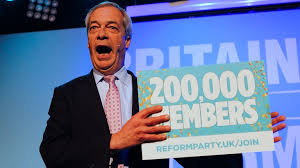
Politics is shrouded in complexity. This is not because reason and truth are difficult to understand, but because it is necessary to dupe citizens about the irrationality of the government’s interests and the activities that lie behind them. Why? Because if everyone were aware that the motives of our leaders are driven by a greed for power, there would be a global revolution.
Consider Reform UK, for example, the bigoted party that is, terrifyingly, going up the ranks in British politics. Research shows that the largest proportion of Reform voters belongs to the working right. This is a demographic that has endured a considerable lack of opportunities in life compared to their middle-class counterparts. It is also a demographic that has, in turn, had a considerably lower level of education than the latter, too. These two factors combined translate to Reform supporters being more receptive to the party’s fearmongering tactics, since they are looking for someone to blame for their misfortune.
‘Don’t look up (at the people in power)’, Reform tells them. ‘Look down (at minorities) – immigrants, gay people, women (insert any other marginalised group that can be turned into a scapegoat here). The source of the cost-of-living crisis can be found in their sin, not in our greed…’
Whereas younger middle-class voters are more likely to question things and, through the media, work things out for themselves, older working-class voters are more likely to go along with and support whatever it says on Reform’s manifesto. It is for this reason that only 13% of 18–24-year-olds said that they would vote for Reform UK, compared to 30+% of 50-65+ year olds. Again, this is due to the lower levels of education that many of the latter have experienced, something which political parties such as Reform UK use to their advantage.
The far right keep the uneducated, uneducated, so that they can frame their lies as the truth and get away with it…
Analysis of the recent election votes shows that in areas where educational achievements were low, Reform received an average of 43% of the vote. In areas where at least 2 out of 5 voters had a degree, however, they received just 19% of the vote. This difference emphasises the extent to which education has an impact on voting decisions and explains why Reform UK has such a black and white, ‘to the point’ attitude in their campaigns, particularly surrounding immigration.
Unlike the Green Party, which focuses on macro issues – environmental protection and climate action, things that affect everyone – Reform UK focuses only on micro issues.
Hate over hope. Division over diversity
Reform UK focuses on topics that they know will hit a nerve with the working-class – the job market, the safety of our children, all the good old ‘British’ values. They then twist them to suit their narrative, all the while condensing a multifaceted, complex issue into a sensationalist headline:
‘SPEAK IN ENGLISH – OR LOSE BENEFITS.’
‘1 MILLION MIGRANTS POUR INTO THE EU.’
‘MIGRANTS TAKE ALL NEW JOBS IN BRITAIN.’
They do this because it’s far simpler to state that ‘immigrants are the problem’ than to go into the truth of the matter: that the class divide and the glass ceiling are the real problems… To do the latter would be to admit that the people to blame are the people delivering the message, and that would be to say that you can’t trust politicians.
‘WhO sAid thAT?!’
And so, this is where we must circle back to the beginning of the article – ‘if everyone were aware that the motives of our leaders are driven by a greed for power, there would be a global revolution.’
Don’t be afraid to revolt.
And remember: The solutions they are proposing apply only to the problems which they created… Problems which don’t exist outside of their own imagination.
 Portfolio of Hope