-
Strikes, Protests, & The Fight To Be Heard
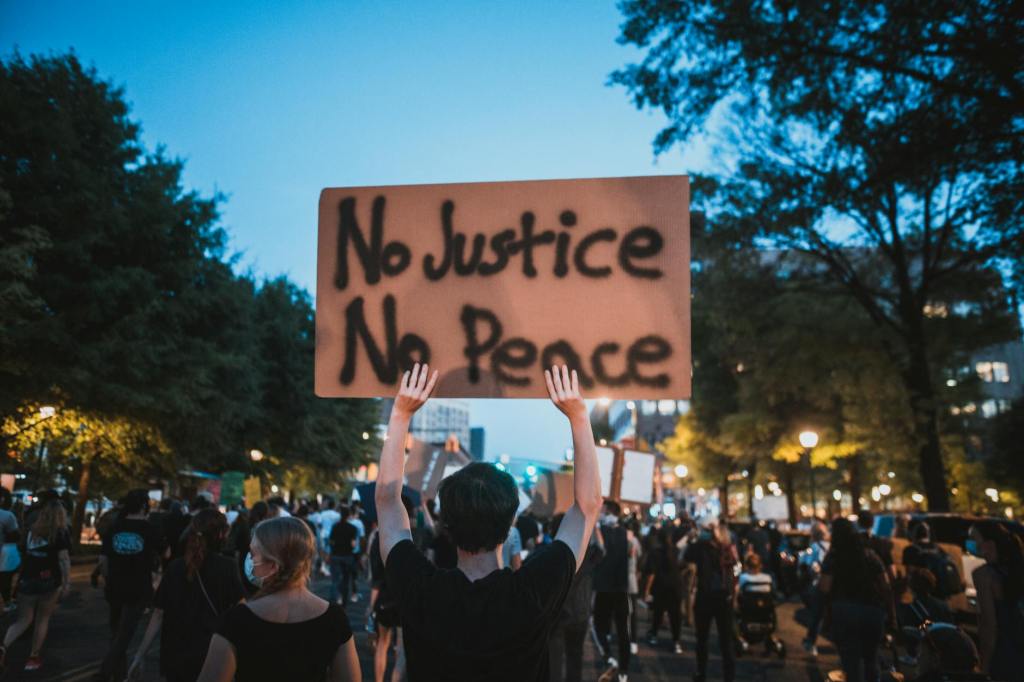
While strikes have long been a defining feature of industrial society — serving as a collective means through which workers demand recognition and reform from those in power — the growing frequency of strikes in the United Kingdom reflects a deepening class crisis.
Historically, industrial action was largely confined to working-class unions in sectors such as mining, transport, and manufacturing. Yet in recent years, professionals such as doctors, barristers, and nurses have also joined the picket lines, signalling that discontent is no longer limited to traditional labour movements. This development exposes the intensification of systemic inequalities inherent in capitalism and the growing inability of the current economic order to meet even the most basic needs of those who sustain it.
The fact that essential professionals — those who uphold the very fabric of society — are now striking demonstrates how thoroughly the capitalist system has failed to protect the interests of labour.
Under capitalism, wealth is produced collectively but appropriated privately. The means of production — factories, corporations, capital, and land — are controlled by a small elite, often referred to as the top 1%, while the vast majority sell their labour for wages that seldom reflect the true value of their work. This disparity has become increasingly visible in contemporary Britain, where CEOs and shareholders accumulate record profits while workers face stagnating pay, rising living costs, and deteriorating working conditions.
The widening gap between the capitalist class and the working population exposes the exploitative logic of modern economies.
Those who control capital continue to extract surplus value from the labour of others, enriching themselves while offering workers only a fraction of what their efforts produce. This inequality is not an unfortunate by-product of the system but a defining feature of it.
As Marx argued, the accumulation of capital in the hands of the few inevitably leads to the impoverishment and alienation of the many. Strikes, therefore, are not merely industrial disputes — they are acts of resistance, organised expressions of class struggle that challenge the injustices embedded within the capitalist mode of production.
The political and economic fabric is fraying, and this discontent is manifesting across multiple arenas — from workplaces to streets, from wage disputes to global calls for liberation. Whether in industrial action or political protest, the underlying cause remains the same: a system that concentrates wealth and power in the hands of the few while marginalising the many.
War, inequality, and exploitation are all rooted in the same foundation… Capitalist greed.
The increasing frequency of strikes among professionals, combined with the surge in mass protest movements such as the pro-Palestine marches, illustrates the scale and urgency of this crisis. Both forms of collective action arise from a shared frustration at being ignored by those in power and a determination to reclaim agency in a system that silences dissent. Yet, in the UK today, protests are increasingly colliding with state power.
At a London demonstration for Palestine, for instance, authorities arrested nearly 900 people — many under terrorism laws — merely for holding placards stating, “I oppose genocide / I support Palestine Action.” Scholars have argued that this reflects a broader pattern of surveillance, censorship, and the criminalisation of dissent.
Why Limiting Protest Threatens Democracy
The repression of protest movements marks a dangerous turn for democracy. The recent wave of anti-protest legislation in the UK, judicial pushbacks against it, and the mass arrests of peaceful demonstrators all point to a growing struggle over the public’s ability to be heard.
When protest is stifled, democracy becomes hollow. The working class and marginalised communities lose their agency; resistance is silenced; and governance becomes increasingly detached and unaccountable.
From a Marxist perspective, such repression is not incidental — it serves to protect the interests of the ruling class.
Limiting protest restricts one of the few remaining avenues through which ordinary people can challenge economic and political injustice. In doing so, the state reveals its allegiance to capital rather than to democratic principles.
The defence of protest rights, therefore, is inseparable from the broader fight against capitalist domination.
Strikes and protests alike must be recognised not as disruptions, but as essential mechanisms of collective struggle and social transformation. To repress them is not merely to limit dissent; it is to erode the very foundations of democracy itself.
-
The Death of a Free Press — and the Rise of ANARKISS

Disillusionment with traditional media is growing. From the BBC — long regarded as “Britain’s most trusted broadcaster” — to the surge of far-right narratives across social media, public trust in dominant rhetoric is collapsing.
Bias in the media is no longer a hidden flaw; it’s a defining feature. And it’s not accidental.
To prevent any genuine challenge from the working class, the billionaires behind social media platforms perpetuate these biases. A truly open space for discussion would threaten their power — so, despite their promises of “free speech,” these platforms are anything but free. They may cost nothing to use, but their control over what can be said or seen comes at a far greater price.
Freedom of the press, once a cornerstone of democracy, is under threat.
Newspaper pages are shaped by billionaire editors, while social media feeds are governed by opaque algorithms. Both mechanisms determine what the public is exposed to, and both serve to narrow the range of perspectives we encounter. The decline in critical coverage of those in power — and the disappearance of opinion pieces that challenge dominant narratives — is no coincidence. It reflects a growing culture of self-censorship within the media industry itself, driven by privilege, profit, and fear of backlash.
Without a genuinely free press, democracy is at risk.
When a small elite — whether governmental or corporate — controls the dominant narrative, corruption festers unchecked. This arrangement may serve the interests of tech leaders and media owners, but it leaves ordinary people unheard and uninformed.
Freedom of the press and freedom of speech are deeply intertwined. Silencing dissenting voices — especially those from marginalised communities — hands control of the microphone back to the powerful few.
If the press isn’t free, neither are we.
What society needs are more platforms that enable honest, unapologetic expression: spaces where individuals can communicate without fear of censorship or suppression.
That’s where ANARKISS comes in.

Founded in 2024 by UK-based writer Lisa Fouweather, ANARKISS is a punk-inspired art and literary zine rooted in countercultural expression. It offers a home to the marginalised and misunderstood — to anyone who feels disillusioned or “othered” by mainstream society.
Part art publication, part political commentary, ANARKISS stands firmly against capitalism, authority, and war. It celebrates gender fluidity, queer positivity, and creative rebellion in all its forms.
In doing so, it upholds the principles of a truly free press:
- Alternative perspectives: It amplifies voices excluded from mainstream media.
- Independence: Free from advertisers, algorithms, and institutional oversight, it has the freedom to take creative and political risks.
- Empowerment: It provides a platform for artists and writers to transform dissent into dialogue, and frustration into expression.
Supporting independent publications like ANARKISS — alongside outlets such as Novara Media — is one of the few ways left to ensure that the stories we consume remain diverse, truthful, and free from corporate influence.
Only through such support can we begin to restore a media landscape that serves people, not power.
-
Lady Gaga and Nietzsche: Exploring the Philosophy of Duality
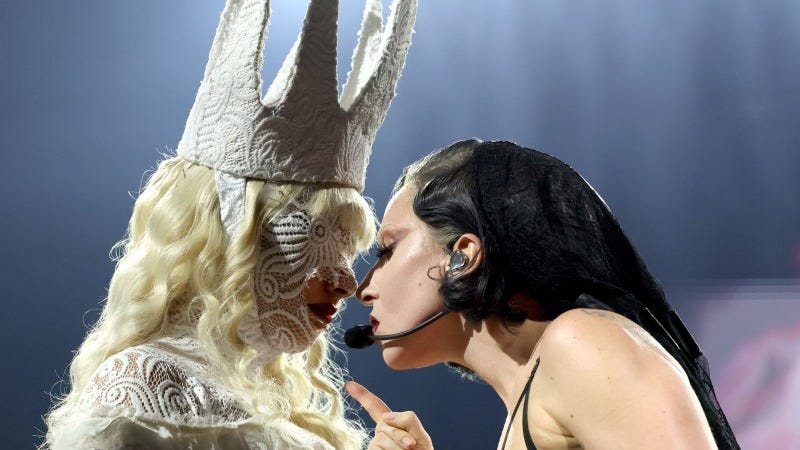
This week, on Tuesday, 07/10/25, my partner and I went to see Lady Gaga in Manchester, UK, as part of her world tour, the Mayhem Ball.
Before we had even set foot into the arena, the tone of the show was obvious. Outfits boasting unapologetic self-expression were the theme of the night.
Someone had recreated Gaga’s iconic ‘caution tape’ costume, adorning themselves in the sticky stuff.
Someone else had recreated her Coachella look, a white bodysuit with a large red cross painted on the front.
Several people had their faces painted to mirror the skeleton makeup from the Born This Way music video.
Whatever the fit, there was so much love woven into each seam, and everyone looked incredible. No one more so than Gaga herself, of course.
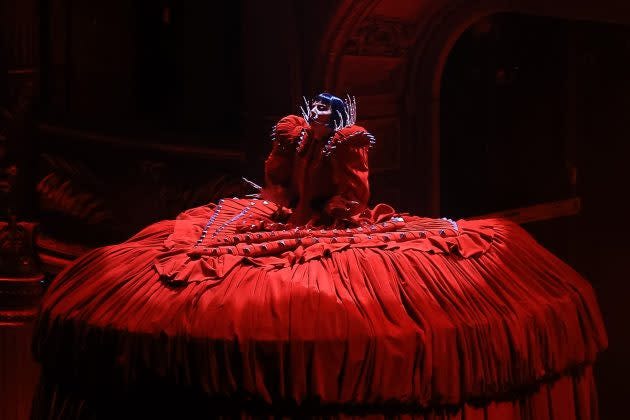
Gaga’s entrance to the stage was in a giant, 20-foot dress reminiscent of a two-story crimson birthday cake. The scale of it all posed a real ‘pinch me’ moment that would go on to last the duration of the 2.5-hour show…
The Mayhem Ball truly is a concert like no other.
What Gaga has created in her career is something far deeper than ‘just’ music… Having been mentored by the great Marina Abramović in 2013, Gaga is a performance artist, blending music, dance, costumes, set, lighting, special effects, video, and poetry to offer the audience a glimpse into her mind.
From Gaga’s powerful vocals to her mind-blowing costumes and set design, the events of this tour are ones that I’m sure people will be retelling for many years to come.
Despite having no standing tickets on offer at this event, the atmosphere made it impossible not to stand… Everyone in the floor section was on their feet from entrance to exit, dancing and letting go.
I say ‘letting go’ because that’s what this concert felt like. An outlet. Escapism.
Coincidentally (or not), one of the songs on Gaga’s latest album, Abracadabra, echoes this sentiment. ‘The category is… Dance or die.’
There is only one option.
You must dance.
‘The world is a chaotic place,’ Gaga said in an interview with French journalist and YouTuber, Hugo Décrypte.
Have the courage to celebrate and dance during the mayhem.
And that we did, together…
Being in a crowd of people who have so much love is one of the most amazing experiences, for when you’ve spent your whole life feeling ‘other’, it provides the perfect antithesis.
We were among our people.
‘God and the gays.’
The show ended with Gaga singing ‘How Bad Do You Want Me’ (see below), having stripped all her extravagant makeup away. It was raw, and it was impactful. The perfect end to a perfect story.
What exactly was the ‘story’?
I’ve seen quite a few reviews online implying that, while Gaga’s performance at the Mayhem Ball was phenomenal, the ‘plot’ didn’t really make sense.
Dig deeper, however, and you will see that it does.
Gaga has created a philosophical masterpiece, taking great influence from Friedrich Nietzsche (1844–1900).

Lady Gaga’s Mayhem Ball embodies Nietzsche’s philosophy of duality, merging Apollonian order and Dionysian chaos to reveal that true art — and true self — can only exist through the harmony of opposing forces.
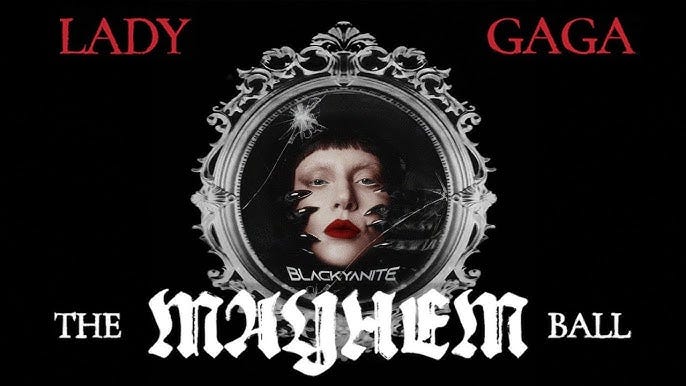
From the opera, “Welcome to the opera house. This is my house”, to the ‘characters’, the Mistress of Mayhem and Gaga, and the album cover, a shattered mirror reflecting two faces (see below), the influence that Nietzsche’s findings on the duality of art have had on Gaga’s creative direction is stark.
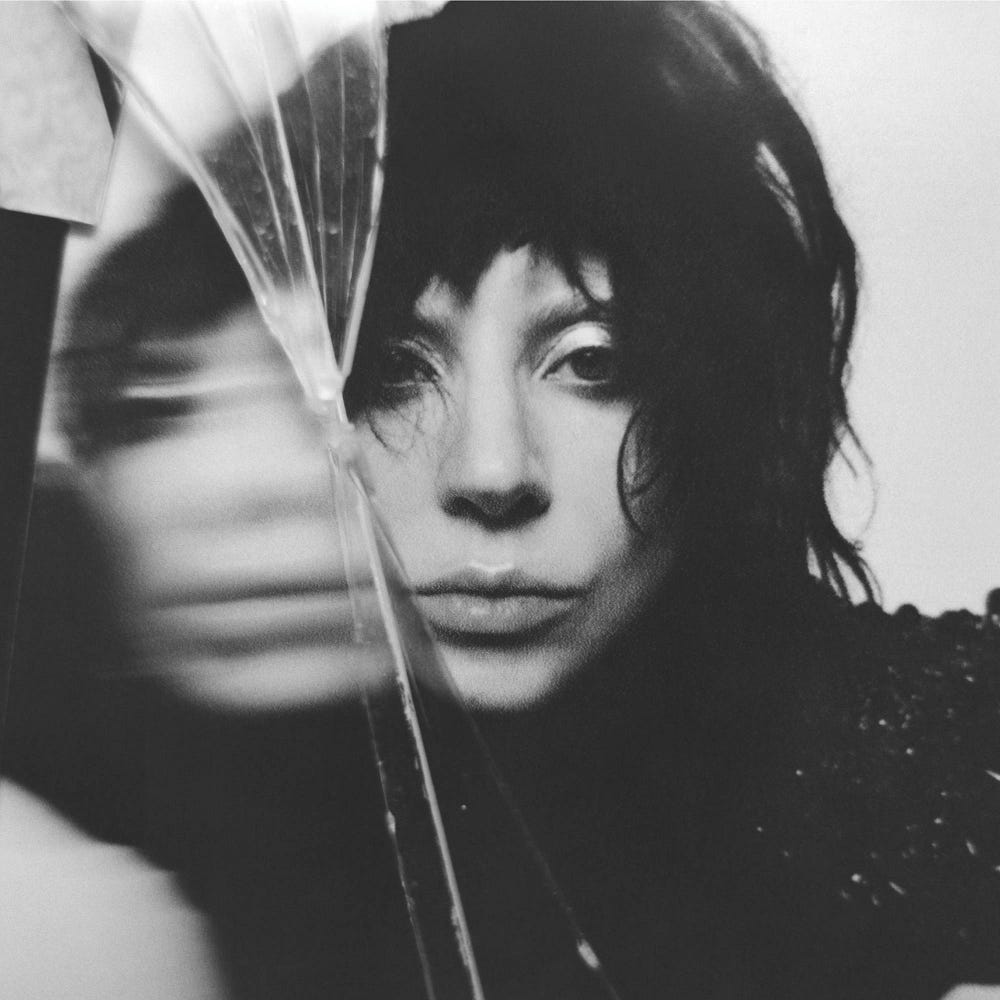
Art is ‘a careful tension between two opposing forces’, Nietzsche wrote in his first major work, The Birth of Tragedy (1872). These forces come from the gods whom the Greeks created to cope with the chaos (to use another word, mayhem) of the world.
Humanity is alone, and facing the whims of fate, the forces of nature, and its own helplessness.
Apollo and Dionysus were the names of the Gods created by the Greeks. They had human traits and were just as moral as they were immoral, going after virtue as much as they sinned.
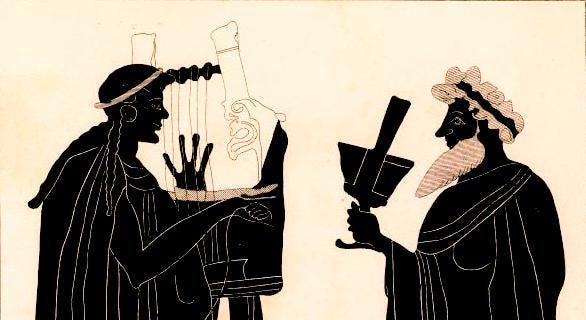
From Apollo comes Apollonian, a term that Nietzsche used to describe a dream state that we understand as our reality. In it, the emphasis is on rationality, logical thinking, self-control, and individuality.
The latter is where the issues arise. There can never be a true depiction of reality in a place where others get left behind. It will always be flawed.
In contrast is Dionysian, a force that comes from the god Dionysus. It represents intoxication and a journey of self-discovery. The ‘discovery’ is always the same — one reaches an ecstatic state, in Gaga’s case, fame, before arriving at a higher realisation.
The Greek tragedy: a fusion of the Apollonian and the Dionysian.
Art, according to Nietzsche, derives its continuous development from the duality of Apollonian and Dionysian, of which there cannot be one without the other.
In the context of Lady Gaga, the Dionysian challenges her, creating ‘dance or die’ situations that push her to confront her fears and insecurities. If it weren’t for the Apollonian bringing clarity in these situations, Gaga would lose herself to a persona.
By uniting the two opposing forces, however, Apollonian and Dionysian, Gaga can express both the light and the dark aspects of her existence.
The two forces might fight, but ultimately, it will all work out. In the end, they will recognise the existence of each other “… and lo! Apollo could not live without Dionysus!”.
This mirrors the end of the Mayhem Ball.

Throughout the show, Gaga, the emotional, thoughtful persona, is seen fighting the Dionysian character, the Mistress of Mayhem. This is a persona who is obsessed with fame, money, and popularity. They feature in songs such as “Paparazzi and Perfect Celebrity”, and are heavily influenced by the ego, wearing extravagant and outrageous costumes that hide their face to deliberately put up a physical barrier between themselves and everyone else.
Although much of the show sees these two personas fighting, the ending sees them coming together, finally.
What is significant about this is that it signifies that we all have these two opposing forces within us. We can try to squash one down in favour of another, but the only way forward is to grant permission for both to exist.
Which is something that Gaga has spoken about in interviews before.
When being pressed with the question of fame, such as ‘how do you deal with it?’, Gaga explains that while she used to struggle, now, she is pretty good at it. Why? Because instead of treating Lady Gaga as a persona separate from Stefanie, now she recognises that they are both a part of her.
And her and I will find a way to live as duelling twins.
It’s important to note here that the influence of Nietzsche’s philosophy spans way beyond Gaga’s latest album.
In her 2011 album, Born This Way, there is one track in particular, “Marry the Night”, that shows how Nietzsche’s influence on Gaga has been a longstanding one. The title itself can be perceived to be a nod to the Dionysian/the darkness.
In the almost 14-minute-long music video (see above), Gaga finds herself in what appears to be a mental hospital. Despite being in the situation that she’s in, Gaga’s thoughts centre around what designer labels are adorning her body.
She enters a dreamlike state, which is perhaps Apollonian, but it’s not reality. It’s an illusion.
The nurses wear next season Calvin Klein, and wear their surgical caps at a tilt on their heads as though they’re berets, “because I think it’s romantic.”
Gaga’s out of it, doing her best to swap reality for fantasy. Even when she’s being spoken to by a doctor, all she can think about is fame. “I’m going to make it. I’m gonna be a star.”
The doctor leaves the room, and Gaga puts a surgical cap on, at a tilt, of course, and starts to dance.
Gaga chooses dancing over dying every time.
In the very last scene, there’s a red lady with a large hat hiding her face, ascending above the flames.

The Mistress of Mayhem has evidently been around for many years, as has Gaga’s message, ‘dance or die.’
The theme of dance is a recurring one (“Just Dance”, “Dance in the Dark”), but what is bigger than that is the theme of duality. The sense of there always being two forces at play.
Death or love.
Dance or die (“Abracadabra”, 2025).
This sense of duality is evident in all three of Gaga’s manifestos.
There is, of course, the Manifesto of Mayhem (see above), which I have already touched upon: ‘Her and I will find a way to live as duelling twins’, but there is also the Manifesto of Mother Monster, which was released with Gaga’s third album, Born This Way, in 2011. In it, Gaga writes:
And as she herself split into two, rotating in agony between two ultimate forces, the pendulum of choice began its dance. It seems easy, you imagine, to gravitate instantly and unwaveringly towards good, but, she wondered, ‘How can I protect something so perfect without evil?’
She can’t.
Nietzsche’s philosophy surrounding duality and the need for both forces to exist in order to create art is evident here.
I find it so incredible how much has been going on in the background with Lady Gaga. She truly is a creative genius. To be able to tie all her albums, of which they span seventeen years, together with a universal thread that is so subtle that only a deep dive such as this reveals truly is a work of magic.
The artistry behind it all is mind-blowing.
Talented, brilliant, incredible, amazing, show-stopping, spectacular, never the same, totally unique, completely not ever been done before, unafraid to reference or not reference, put it in a blender, shit on it, vomit on it, eat it, give birth to it…
Lady Gaga, everyone.
What a phenomenal woman.
-
How To Overcome Writer’s Block In Poetry

Sometimes, when I sit down to write a poem, my mind goes blank.
I have a prompt in front of me, yet I pick up my pen only once in one whole hour to ask a question that I already know the answer to…
What is a poem?
I have a master’s degree in creative writing. I know what a poem is, but unfortunately, I also know what imposter syndrome is.
I’m not good enough for this.
When poetry is simply an expression of the human experience through the written word, there is no right or wrong, for it is deeply personal and therefore wholly subjective.
Sure, there is a structure to follow in some cases (haikus, for example, must have a line count of three and a syllable count of 5,7,5), but there is also an abundance of poetry that has no rules (see also: free verse).
Free verse poetry is my favourite type of poetry because, rather than selecting words to fit a specific structure, you can instead select a structure (or not) to fit your words.
In whichever way you write poetry, whether structured or unstructured, the not-so-secret ‘secret’ to writing is just to start.
I, you, we, can therefore let go of the idea that we’re somehow ‘not good enough for this.
Take inspiration from other poets. The Poetry Archive is an amazing website that is free to use and acts as a library. Notice how many different styles of poems are on there. Notice the absence of rules.
To repeat again: there is no right or wrong.
One person’s messy soul looks very much like another person’s messy soul.
Despite our experiences being unique, based on an interwoven thread of memories that only we have lived, when we are all far more alike than we are different, poems are often universally relatable.
A poem about grief, for example, however specific it is to the poet’s experience, is a poem about love and loss, which are themes that we can all relate to.
Why poetry?
What makes poetry so special is the way that it allows the writer to take individual words that essentially mean nothing on their own, and put them together in such a way that makes people feel.
Because, to answer the question that I ask myself all too often while sitting at my desk twiddling my thumbs, ‘what is a poem?’, it is this…
A mutual exchange between writer and reader…
A way to feel.
Stop worrying that you’re going to do it wrong, and just write how you feel.
-
What Makes An Artist An Artist?
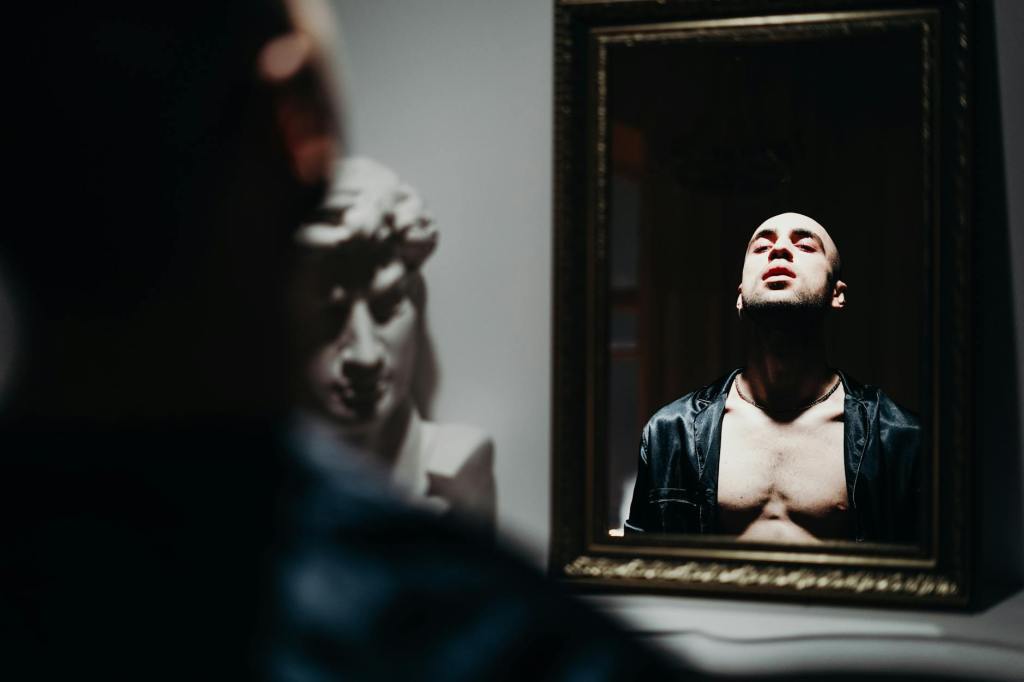
People have debated, for centuries, what makes an artist an artist. Their ability to ‘not see the world in black and white’ is a common explanation that is put forward. The reality, however, is that artists do in fact see the world in black and white. It is everyone else whose perception is skewed…
Unlike the general population, who tend to go through life like a sponge, soaking up what they are told, unquestioningly, artists look beyond authority in order to strip back the layers.
Like moving house only to find every room covered with carpet, it is an artist’s job to rip that material up and restore the home to its original features.
In other words, it is an artist’s job to see the world for what it is, in all its original glory, not what society has told us it is through cover-ups and fabrication.
It is for this sense of non-conformity, one could argue, the refusal to believe something just because someone has told you it’s true, that explains why queerness is so prevalent in the arts.
When sexuality itself is something that society has made us believe can either be ‘right’ or ‘wrong’ and not just be, it takes a certain type of person to see beyond that. Many can’t see beyond it, or if they can, it’s a long journey, and this is where internalised homophobia arises. The sense of who you are being wrong because society has told you that it’s wrong, ‘so it must be…’
Strip back the layers, though, and we realise that queerness has always existed. We can see that through nature*, the purest form of life. Nature is untampered with, yet it is still queer.
*Nature is a theme that I continuously go back to in my writing, because through connecting with nature, we connect with ourselves.
If therapy isn’t working out for you, go climb a mountain.
Like sexuality, there are countless aspects of life that society has adapted to suit whatever the trend of the moment is. Women’s bodies provide the most prominent example…
The ideal body type is constantly shifting. Currently, we are seemingly reverting back to the incredibly dangerous ‘heroin chic’ era, where emaciation appears to be the desired look.
Realising how profitable self-hate is, businessmen have exploited this, (where ‘this’ is a mental health crisis), and turned it into yet another unethical money-making exercise.

Photo by Arina Krasnikova on Pexels.com From controlling women’s bodies to controlling men’s behaviour, and everyone and everything in between, society is the antithesis of nature. The two can co-exist, but certain people, with such power hunger, make it incredibly difficult for that to happen.
To strip society of its self-imposed hate requires a complete overhaul of the system, and to do that, first, we must be awake. This is where artists come in. They can help the public to reframe their thinking to one of not blind acceptance, but curiosity.
The urge to ask… ‘why?’
Artists uncover what the system wants to stay covered, knowing that if people can’t see something, then they can’t change it.
Some do so in more covert ways, using poetry, for example, within which they drop subtle metaphors to lead the reader to make their own conclusion. Others, however, do so in more overt ways, through painting a mural on the Royal Courts of Justice depicting a judge hitting a protester over the head, as just one timely example…

Whatever method they choose to deliver their message, though, all artists have one unwavering thing in common: they are in the business of awakening and enlightening in order to:
- Guide people on their journey of rediscovering what life is actually about.
- Encourage people to look outside of the bubble that is society.
- Uncover the carpet to reveal what lies underneath.
When it becomes about fame and popularity over social justice, the arts will have outlived its purpose, but until that point (and may we never get there), we should all be supporting independent artists and creators where we can.
Without artists holding up a flashlight, the world would be a very dark place indeed.

-
Reimagining Childhood: Embrace Your Inner Child

Children today are growing up far too quickly. Consuming news through social media outlets that even adults would struggle to process, their phones have replaced their mothers’ hands as they seek comfort from the uncomfortable.
‘Influencers’ like Andrew Tate and the late Charlie Kirk are shrouding the judgement of the many at the expense of the few – women, the LGBTQ+ community, anyone and everyone that society deems ‘other.’
Many of the far-right ‘influencers’ that are around today won’t even believe their own rhetoric, but knowing that the shock factor, ‘I can’t believe he just said that!’, sells, they will push it forward anyway, harming a whole generation in the pursuit of fame.
Alas, this is creating a worldview that is shrouded in hate for minorities. It is creating fear amongst the marginalised and a superiority complex amongst the majority.
Allow this to continue, and we enter a very dark time indeed…
Educate the children and it won’t be necessary to punish the men.
Don’t get me wrong, there is so much good that comes from social media. It allows for a degree of freedom of expression that has never been seen before. It fosters creativity and free speech and is a great way to connect with other like-minded people. It gives children an advantage in academia that they have never had before, and access to a job market that didn’t even exist prior to its inception, but behind all this, the same things that make social media so great also make it so terrifying.
The ability to say whatever you like unvetted has paved the way for so much hate at a time when, more than anything, we need love and togetherness.
Repeat: We need love and togetherness.
Unfortunately, though, this is what is missing.
We have become so aware of our perceived differences that we have forgotten how much closer we are than we are apart.
We have closed our minds off and forgotten what resides within each of us, our inner child.

Photo by Liubava Fedoryshyn on Pexels.com Like a ghost, although our inner child remains largely unseen, having been silenced by the noise of modern-day society, where ‘CONSUME! CONSUME! CONSUME!’ echoes around a void that only money seems to fill; they are ever-present, nonetheless.
And, also like a ghost, our inner child is, all too often, misunderstood.
We catch glimpses of it/him/her; however you refer to your inner child, and many of us become frustrated.
‘Why can’t it just leave me alone?’
Our inner child can follow us around like a dead weight (ghost pun unintended) and make us feel like we will forever be chained to the past.
This is where we must reframe our thinking. We are not chained to the past in the sense that we are oppressed by it; our inner child is not something we must try to outrun. We are connected to our inner child in the sense that we can learn from it.
We can all learn from the sense of wonder that a child feels when a butterfly lands in the palm of their hand and they feel like they’re holding the world. Something so delicate yet so strong at the same time.
The innocence of childhood is what is missing from life.
Next time you witness a sunset and your eyes well up and you can’t understand why, and you quickly reach into your pocket for a tissue to wipe away any sign of life behind your eyes, I want you to ask yourself…
Why?
‘Why do I feel the need to hide my sensitivity when my emotions are the very thing that makes me human?’
Remembering that a child is within each of us can help us to make better decisions when we feel compelled to suppress ourselves, or ‘tone it down’ to create a more ‘palatable’ version of us.
Like ghosts, we are all simply misunderstood children trying to find our way back home.
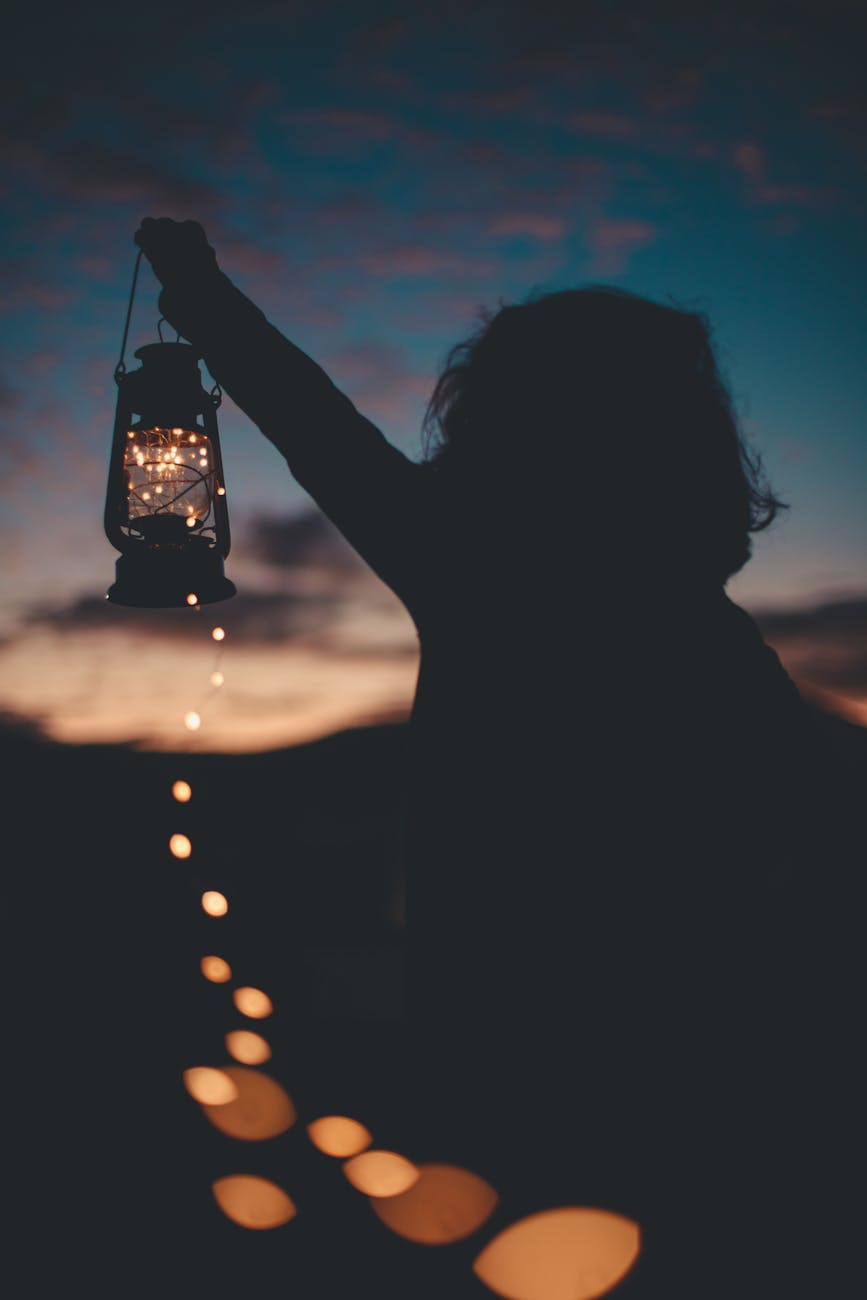
Do that kid a favour, won’t you, and switch on the light.
-
The Assassination of Charlie Kirk: Fighting Hate with Hate

I have seen a lot of comments going around the internet surrounding the assassination of Charlie Kirk, many of which are… questionable, to say the least. I wanted to use this platform to post my take on the whole thing, too.
Firstly, if you don’t know who Charlie Kirk is, he is (or rather was) an American activist and media personality, and a close ally of US President Donald Trump.
Kirk had, let’s call them ‘radical’ views. Taking a far-right stance, he was against liberalism and wasn’t afraid to tell the world about it. This is how he gained his fame, through debates. This is also how he was killed.
Charlie’s outspokenness gained him praise from some and criticism from others who likened him to a fascist.
In the eyes of his admirers, Charlie Kirk rose to fame because he was willing to challenge norms and broaden the scope of acceptable debate — especially on heated cultural issues.
To his critics, however, Kirk’s rhetoric was inflammatory, passed off as debate that was actually toxic and dangerous.
Kirk was against gay marriage and abortion, argued for Christian nationalism, and was highly critical of Islam. He famously said that gun deaths were “worth it” for the right to own firearms. He was also an opponent of diversity programmes and spread falsehoods about topics such as COVID-19 vaccines and voting fraud. Above all that, though, he was a human.
Political disagreement cannot be, and must never be, a death sentence.
I disagreed with everything that Charlie Kirk was about, but I would never have wished death upon him.
There are countless voices I wish I could silence. Here in the UK, Tommy Robinson comes to mind first, and in the US, Donald Trump, but what is needed is education, not a gun.
The ability to debate ideas freely, whether you agree with them or not, and to speak your mind without fear of violence is what distinguishes democracy from tyranny.
It is impossible to be liberal if you wish death upon people who don’t share your opinion, when the very definition of liberalism is:
A willingness to respect behaviour or opinion that differs from one’s own.
Death as a mirror
The death of Charlie Kirk is not ‘poetic justice’, as I am seeing people argue on social media. It’s not something to celebrate. It’s a mirror. A reminder that fearmongering doesn’t protect you, and prejudice doesn’t save you.
The violence that Kirk justified, excused, and weaponised in words is the same violence that claimed his life.
The moment you reach for a gun instead of a microphone is the moment you lose the debate.
The story ends not with vindication, but with proof of what was true all along: the enemy was never one community. The enemy was always the hate. The gun. The system that keeps both alive.
And so, Charlie Kirk’s killing should serve as a stark warning. Not to people who speak their mind. We fought for freedom of speech, and it is a human right endowed upon us all. But to people who believe that the answer to opposing views is violence.
Like trying to put fire out with petrol, you can’t act with hate and expect to achieve peace. The two can never coexist.
The world needs more love and less hate.

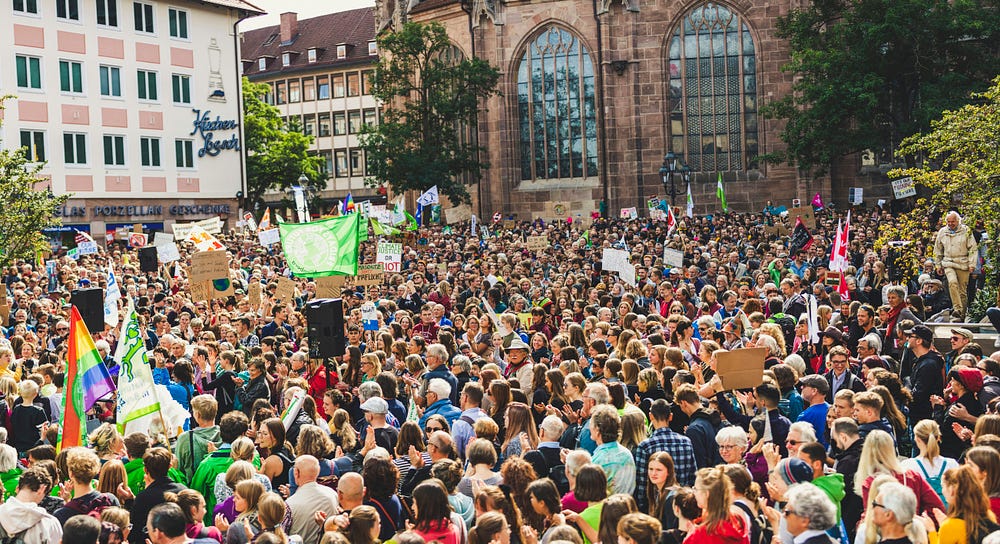
Source: The Guardian Using a recent protest in the UK as an example (in the image above, counter protestors can be seen dancing, while far right protestors moaning about asylum seekers are chanting racial abuse), the impact that a little bit of light can have in the dark might surprise you.
The only thing that darkness cannot coexist with is light.
-
UN Report Confirms Israel Is Committing Genocide In Gaza

After two years of relentless war and bloodshed, the United Nations has finally declared that Israel is committing genocide in Gaza.
‘It is clear that there is an intent to destroy Palestinians’, the UN report claims.
Israel is, unsurprisingly, rejecting the report’s findings. A spokesperson has called for the UN Commission of Inquiry to be abolished, arguing the case of antisemitism (again), the same argument they used last year when the International Criminal Court (ICC) issued an arrest warrant against Netanyahu.
At the time, the then US President Joe Biden called the warrant “outrageous,” and his successor, Donald Trump, issued an executive order to introduce sanctions against personnel from the ICC, while inviting Netanyahu to the White House.
Based on the collective response last year, it is hard to believe that either Israel or the US will be any more accepting of this year’s report, especially when Israel has long claimed that the UN is ‘biased against it.’ This is despite the commission having been studying the conduct of Israel since the Hamas attacks back in October 2023. Only after reviewing two years’ worth of evidence have they concluded that Israel has committed four of the five acts laid out in the Genocide Convention.
The UN is not out to get Israel; they are out to protect the world…
The report alleges that Israel has been forcing Palestinians to live in inhumane conditions, causing serious bodily and mental harm, including through torture, and imposing measures intended to prevent births*.
*The latter point is linked to an attack on the Al-Basma IVF clinic in December 2023, which the commission claims destroyed around 4,000 embryos and a further 1,000 sperm samples.
The report also alleges that Israeli military personnel have carried out sexual and gender-based violence, including “rape and sexualised torture”, as part of “a pattern of collective punishment”, and accuses Israeli forces of deliberately targeting some children “with the intention to kill them”.
More than 10% of Gaza’s population has been killed or injured, former Israeli military chief says, the majority of whom are women, children, and elderly people. Not the most dangerous, but the most vulnerable…
There is so much evidence that Israel is committing genocide, even in GHF sites, aid distribution sites, supposedly, that were set up by Israel with American help earlier this year.
Journalists have found that aid distributions by the GHF are associated with a significant rise in deaths, something which UN experts describe as a ‘disturbing example of how humanitarian relief can be exploited.’
You don’t need me to tell you how wrong what is happening in the Middle East is, but what I will tell you is that today has been the most haunting day of the war yet.
Instead of the UN’s declaration of genocide stopping Israel, it has done quite the opposite.
Following the release of the UN’s report, Israel’s military has expanded its ground offensive, killing at least 68 people across Gaza since dawn. This brings the current death toll to 64,718.
Now that the UN has named this for what it is, genocide, no longer can anyone condone Israel’s actions, least of all our government.
We need to stop arming Israel.
Since December 2024, the Royal Air Force has conducted at least 518 surveillance flights around Gaza.
The flights, carried out from Cyprus, have been shrouded in secrecy, raising concerns about whether British intelligence has played a role in military operations that have resulted in mass civilian casualties in Gaza.
While the Ministry of Defence claims these flights are solely for locating Israeli hostages held by Hamas, evidence suggests otherwise.
It has been found that the RAF conducted 24 flights in the two weeks leading up to and including the day of Israel’s deadly attack on the Nuseirat refugee camp on 8 June 2024, which reportedly killed 274 Palestinians and injured over 700.
The British and US governments need to stop playing their part in genocide.
What happened on October 7th, 2023, was horrific, the worst terrorist attack in Israel’s history. I have seen the videos from the day, I forced myself to watch them to see both sides, but to continue to punish innocent Palestinians two years on for the actions of a group that they are in no way affiliated with makes no sense.
What Israel is inflicting upon Gaza is genocide, pure and simple, no excuses. And we and our governments owe it to the future to be on the right side of history.
Free Palestine.
-
When Nepal’s Youth Said ‘Enough’: An Uprising for Hope and Justice
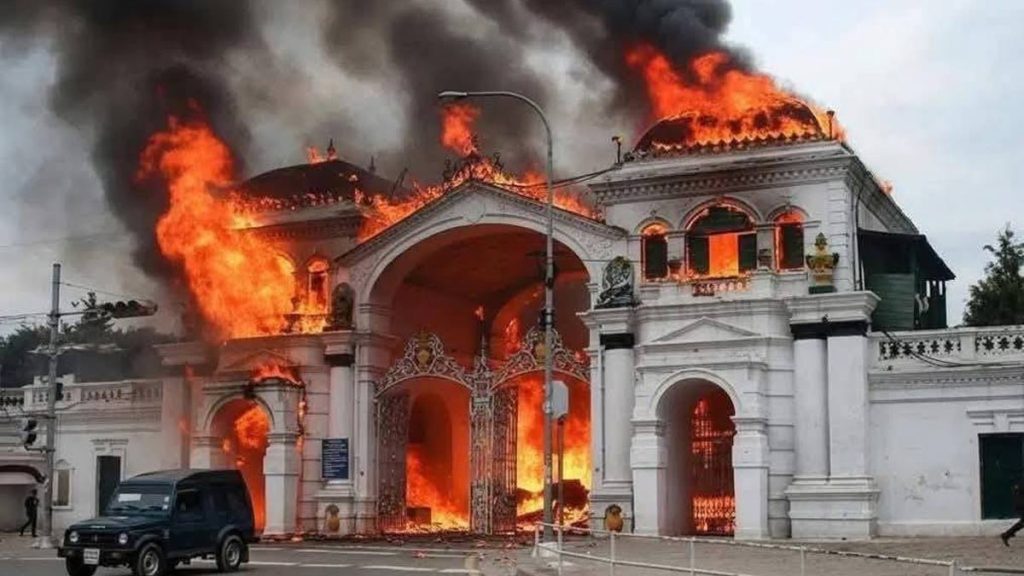
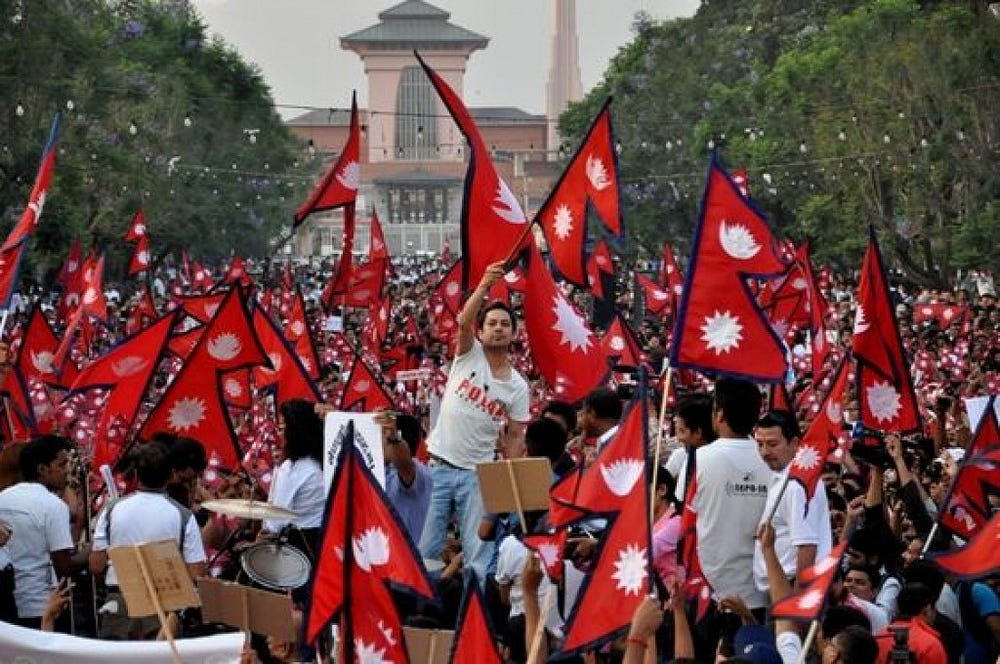
Triggered by the government’s decision to ban 26 social media platforms, including many of the giants, such as WhatsApp, Instagram, and Facebook, young people in Nepal have had enough.
They have had enough of an attack on free speech being disguised as a mission to tackle ‘fake news.’
They have had enough of being treated like second-class citizens, while the 1% (and their children) get to live the high life.
They have just…had…enough.
And, what happens when someone has had enough of something?
As the history books show us, they fight back…
We will launch another revolution, but it will not be like the last People’s War, a PLA soldier told the media.
And that they did.
What began, seemingly as retaliation against the social media ban, has grown to embody much deeper discontent with Nepal’s political system as a whole. This is why, despite the ban being hastily lifted, the protests continued to gain unstoppable momentum.
Nepal has been plunged into chaos, with this being the prime example of what happens when power corrupts…
The people fight back.
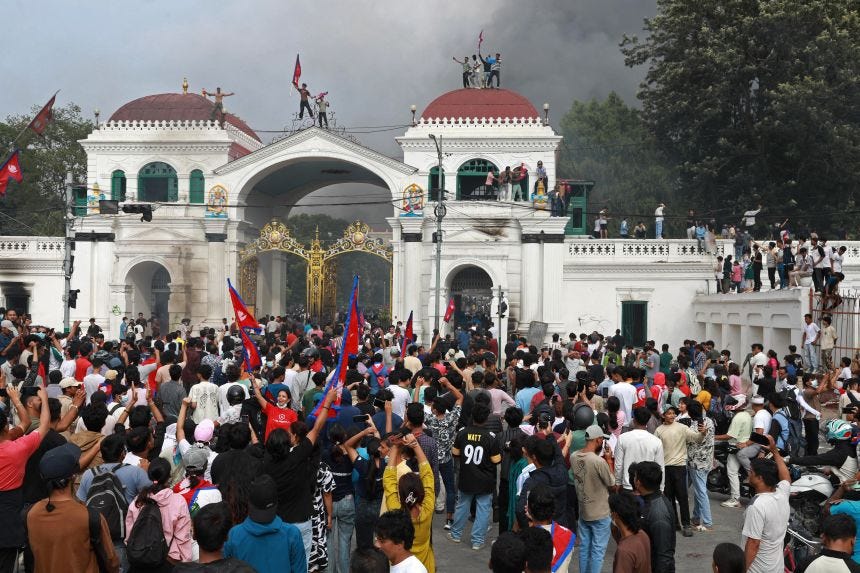
Along with government ministries and residences, dozens of other properties have been set on fire by protestors, including a luxury hotel and a prestigious private school.
The prime minister has stepped down due to all the conflict, during which politicians’ homes were vandalised, and government buildings and parliament were torched.
Sujan Dahal, a young Nepali celebrating the prime minister’s downfall, said of the protests, “This is a revolution. This is the end of the corruption. It’s our turn now.”
We demand a transparent and stable government that works in the interest of the people and not for the benefit of corrupt individuals or political elites.
Some of the potential demands that the protestors could make include the dissolution of parliament, new elections within six months — or, at most, a year — and possibly, a mechanism to directly elect the prime minister (like other parliamentary systems, at present, it is the party that comes to power that chooses the prime minister).
Term limits for prime ministers, and a reduced term for parliament — from five years to four — might also figure in their demands.
Lokranjan Parajauli, a social scientist who has written extensively on social movements and politics, suggested the next ruler is likely to be an “independent” figure not aligned with any party.
Ultimately, as long as the country’s leaders listen to what they have to say and take their demands seriously, they will have no need to fight anymore.
Alas, the protests have not, however, been without fighting.
Although the prime minister has resigned, and most senior politicians are in hiding, the protestors have not been left to ‘get on with things’ without challenge.
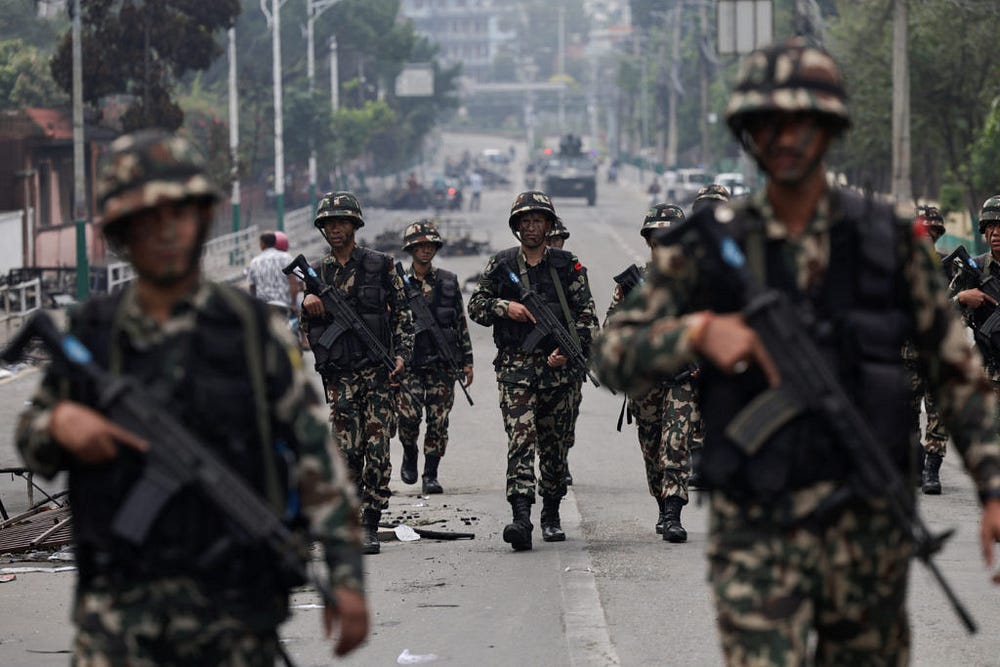
Over 50 people have been killed and dozens more have been injured during demonstrations as the army patrols the streets.
Although such unrest, to the world, might seem like it has come from nowhere, it does, in fact, sit within a long history of fragile democracy.
The Last People’s War
Over three decades ago, in the year 1994, a new party was founded in Nepal; the CPN (Maoist Centre). This was a result of one party, the CPN (Unity Centre), splitting into two.
Just two years after the Maoists formed a collective, they launched an armed struggle against the Nepalese government and its state forces. A civil war broke out as a result.
For many, the civil war — referred to as the People’s War by the Maoists — was a fight against discrimination and oppressive social hierarchies — whether based on caste, gender, wealth, ethnicity, religion, or region.
About a third of the fighters were women. They were drawn to revolutionary politics because they saw in it an opportunity to challenge a patriarchal system that considered them inferior to men.
The war ended after a peace accord was signed in 2006. The purpose of this was to allow the Maoists to join the government, a government that they would go on to rule…
In their first sitting, the Maoists scrapped the 240-year-old Shah monarchy. They had been calling for the monarchy to be abolished since India’s freedom struggle against the British.
The following year, the country was declared a democratic republic.
It’s not a coincidence that so few people are aware of Nepal’s history…
Governments don’t want us to see the outcome of people coming together to fight for a common cause, because they worry that it could inspire us to start a revolution of our own.
As the Maoists have proven, we, as the people, don’t have to accept what they, as the leaders, impose, and that should leave us all with a glimmer of hope for a brighter tomorrow.
The world right now is a scary place. There is so much happening that could very quickly escalate into something far greater than we are prepared for. With Russia testing its waters with Poland, and the far-right gaining seemingly ever-growing momentum across much of the Western world, it’s difficult to remain positive in the face of such corruption.
What’s important to remember, however, is that you, we, don’t have to remain as passengers in our lives. We can all decide to swap seats and be the driver(s) instead.
Get your voice or your words or your art, preferably all of the above, out there. If it doesn’t feel like anyone is listening, have faith that people are.
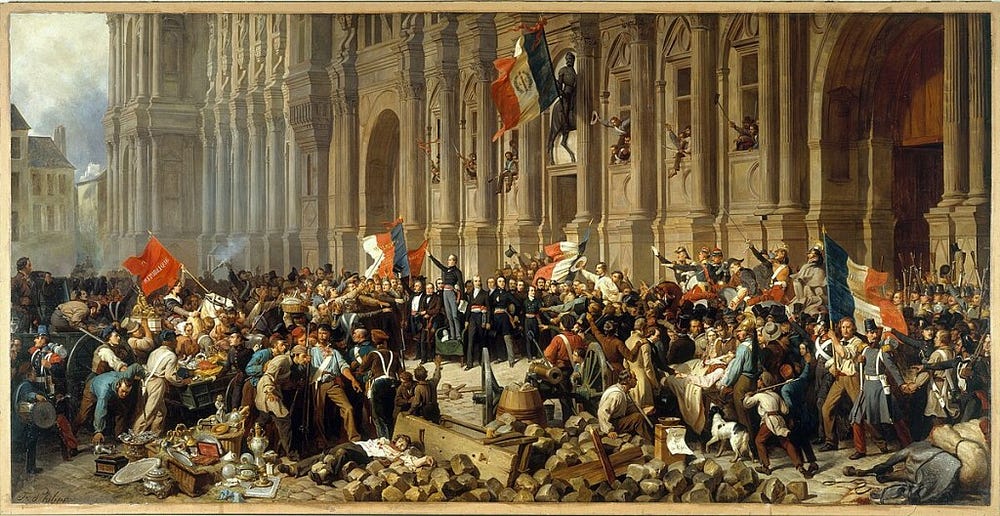
Had someone not decided ‘enough is enough’ in Nepal, there would still be people starving to death while the monarchs host feasts for ministers in their palace (sound familiar? I’ve never stepped foot in Buckingham Palace, but I can picture a similar scene, and it’s a mirror image of the French Revolution) …
The overarching message is that if you let people get away with things, there will come a point when they push that little bit too far, and before you know it, you’re standing with a placard begging to have your human rights back.
Don’t let it get to that point, please.
A tale as old as time, always remember that prevention is better than cure.
It’s not about ridding the world of governance, as the French Revolution demonstrates; there is a recurring pattern in human societies. When a government collapses, individuals will inevitably seek to seize power. The revolution’s journey from overthrowing a monarchy to the establishment of an empire under Napoleon shows this. It’s about ridding the world of inequality.
We need leaders who seek to lead for the greater good, not control for the sake of having power.
Only when we have this will there be world peace.
Here’s to the abolition of power, not the mere shift of it.
-
The Censorship of Banksy: A Cover-up of Art or Fascism?
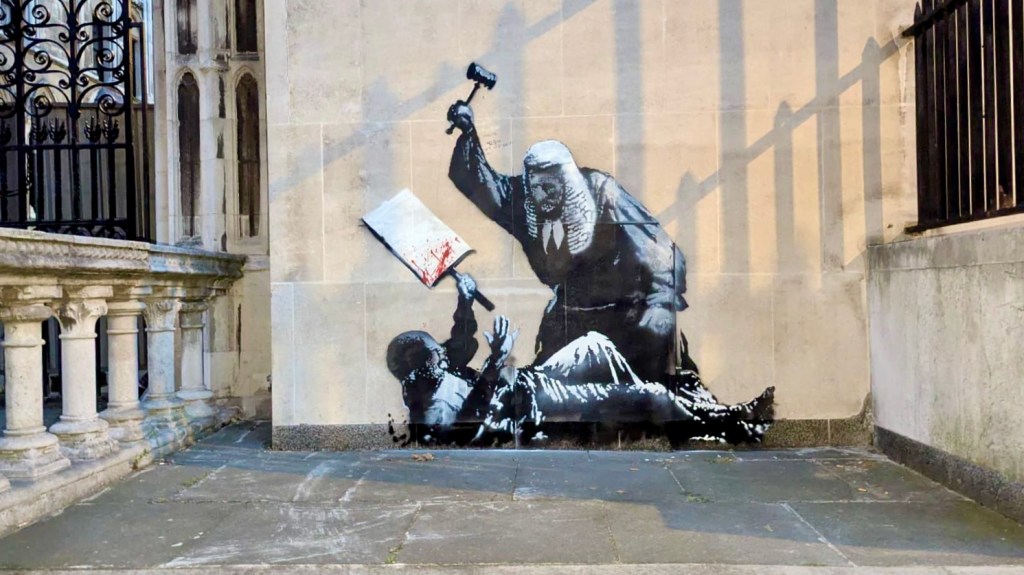
This week, a mural appeared on an external wall in the Royal Courts of Justice, London, depicting a protester holding a white picket sign spattered with red paint, meant to represent blood, and a judge towering over him.
The artist behind the mural was immediately obvious…
It was the work of Banksy.
Despite being worth millions and providing a new tourist hotspot, the mural was immediately covered up by Metropolitan Police officers.
If bias in the censorship of art wasn’t obvious before, it certainly is now.
The eradication of Banksy’s piece is not so much a cover-up of art so much as it is a cover-up of fascism, one could argue…
The artwork came two days after hundreds of demonstrators were arrested in central London for protesting the banning of Palestine Action as a terror group.
Banksy’s work of art on the walls of the Royal Courts of Justice powerfully depicts the brutality unleashed by Yvette Cooper on protesters by proscribing Palestine Action.
Silencing a work of art about silencing protest? Maybe it was a little too close to home, proving the lengths that the people in power will go to in order to hide their corruption.

The power of art
The attempted removal of Banksy’s most recent mural failed. There is still the perfect shadow of the art on the wall (see the image above), and, if anything, it’s now even more impactful than the original.
A source of hope, it reminds us of the power of art and its ability to leave a lasting impression on society.
Encouraging a national dialogue is something that underpins Banksy’s work…
Aimed as a form of cultural criticism (like the mural on the Royal Courts of Justice, many of Banksy’s pieces are critical of government policy, war, and capitalism), Banksy often targets established social and political agendas. He loves to make the elite the punchline.
The art world is the biggest joke. It’s a rest home of the overprivileged, the pretentious, and the weak.

Through graffiti, Banksy aims to start revolutions
The world became more* aware of Banksy in 2003 following his creation of ‘Love Is in the Air’, also known as the Flower Thrower. The graffiti was made on the 760km wall that separates Palestine from Israel (see above).
Banksy returned to the West Bank’s concrete wall in 2005, where he created a series of images depicting ideas about escape, including a girl floating away with a group of balloons, a boy painting a ladder, and two children with a bucket and spade, dreaming of a beach.
*Banksy has been creating murals/street art since the early 1990s, with his first known large wall mural being ‘The Mild Mild West’ in Bristol, but the turn of the 21st century is when he won international acclaim.
Banksy confirmed that he was behind the work in a statement that he released following its appearance. In it, he called Palestine the world’s ‘largest open prison.’
Over a decade later, he did something similar in his design of the Walled Off Hotel in Bethlehem, West Bank, Palestine. Established in 2017 and initially set out to only be a temporary exhibition, the hotel has since attracted nearly 140,000 visitors.

Never one to do things by halves, Banksy created Walled Off as a 10-room boutique hotel, a protest, and an art gallery all at once. Banksy hoped the venture could provide a boost in tourism and job opportunities to Bethlehem, which had suffered increasing Israeli control over travel.
Opening in 2017 was a significant choice.
2017 marks a hundred years since the British took control of Palestine and helped kick start a century of confusion and conflict, Banksy wrote on the hotel’s website.
Each room in Banksy’s hotel looks out onto the illegal concrete barrier, which separates Israel from the Palestinian territories. Banksy boasts it is “the worst view of any hotel in the world”.
It is intended to provoke productive political conversations within a more local region as well as globally.
Sparking much-needed conversations surrounding social justice and our need for more is something that Banksy will strive to do, at whatever cost.

In Bristol, where Banksy started out, the year 2006 saw the local council clamping down on street art. Banksy wanted to make a statement against this with a large piece directly opposite the main council building. However, this area had a lot of security, and he would not have been able to get away with it on his own.
Instead, he hired a legitimate scaffolding company to erect scaffolding up the wall he was targeting, claiming to be working for the council on a repair. They put up the scaffolding and sheeted it, so you could not see inside. As far as anyone was concerned, it was just normal maintenance.
Banksy worked overnight under the scaffolding to create the mural, and the scaffolding came down the next day, so by Monday morning, the council leaders could see it from their office windows. This placed them in a dilemma:
- They were clamping down on illegal street art and graffiti across the city.
- This was illegal street art.
- It was on a council building, right in the middle of town, and highly visible.
- It was a Banksy, and potentially worth millions.
19 years later? It’s still there…
Referring back to Banksy’s most recent mural on the Royal Courts of Justice, one cannot help but question why this was removed (well, attempted to be removed), whereas the mural that he created during a council clampdown on street art remained.
Is it the difference in subject matter? Unlike the recent mural, which is very politically charged, Banksy’s 2006 mural, named ‘Well Hung Lover’, is more… palatable?
What are the authorities trying to hide?
It’s easier to digest infidelity as opposed to inhumanity, is essentially the takeaway…


 Portfolio of Hope