-
GENESIS 37:9 – Because It’s Sunday And We Are Free

Entangled in our love
and feeling no shame,
we spend the morning in bed
lying breast to breast,
with their cries of‘But it’s a sin.
Women should not lie with women
as women lie with men’echoing around the void,
unclaimed,
their impact devoidwhen the sun
and the moon
and the stars
bow down to us,and suddenly the sky above
seems closer than the flames below,
and we feel no shame for lying with woman
as woman lies with man,because it’s Sunday,
and we are free. -
Cursed Is The Man
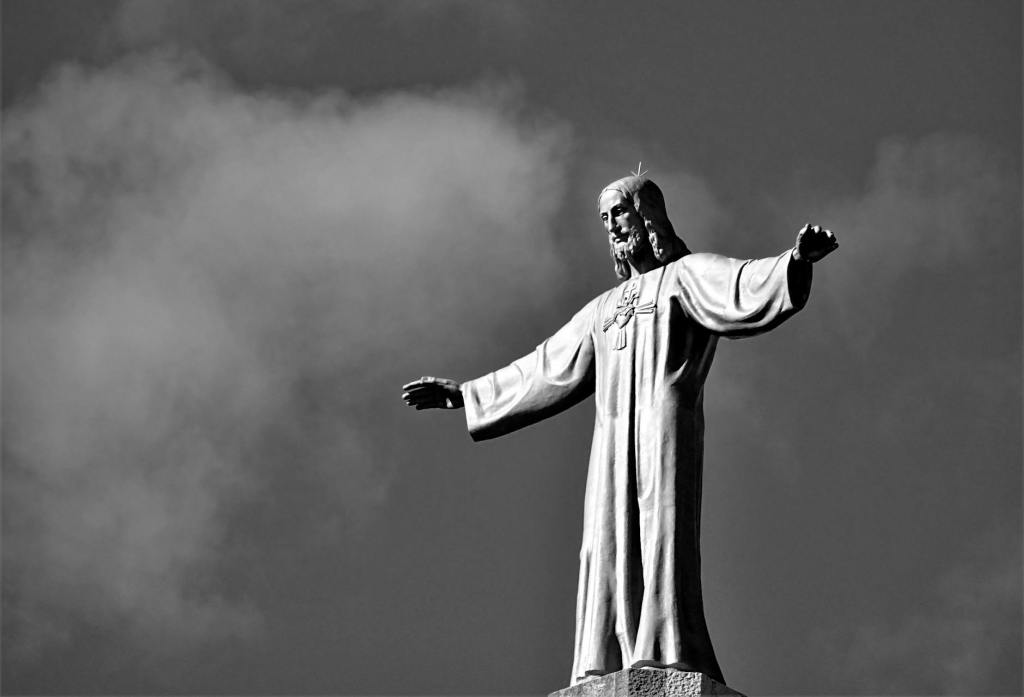
Cursed is the man
Who prides himself
On his ability to get you to obey.I say,
Cursed is the man
Who absolves you of your sins
(Except, of course, if you’re gay).I say,
Power corrupts
When religion instructs:
‘Your sins don’t count if you pray them away.’I say,
Cursed is mankind
Who are yet to wake up
To what is staring them right in the face. -
Censorship Of Art Is The Antithesis To Freedom Of Expression
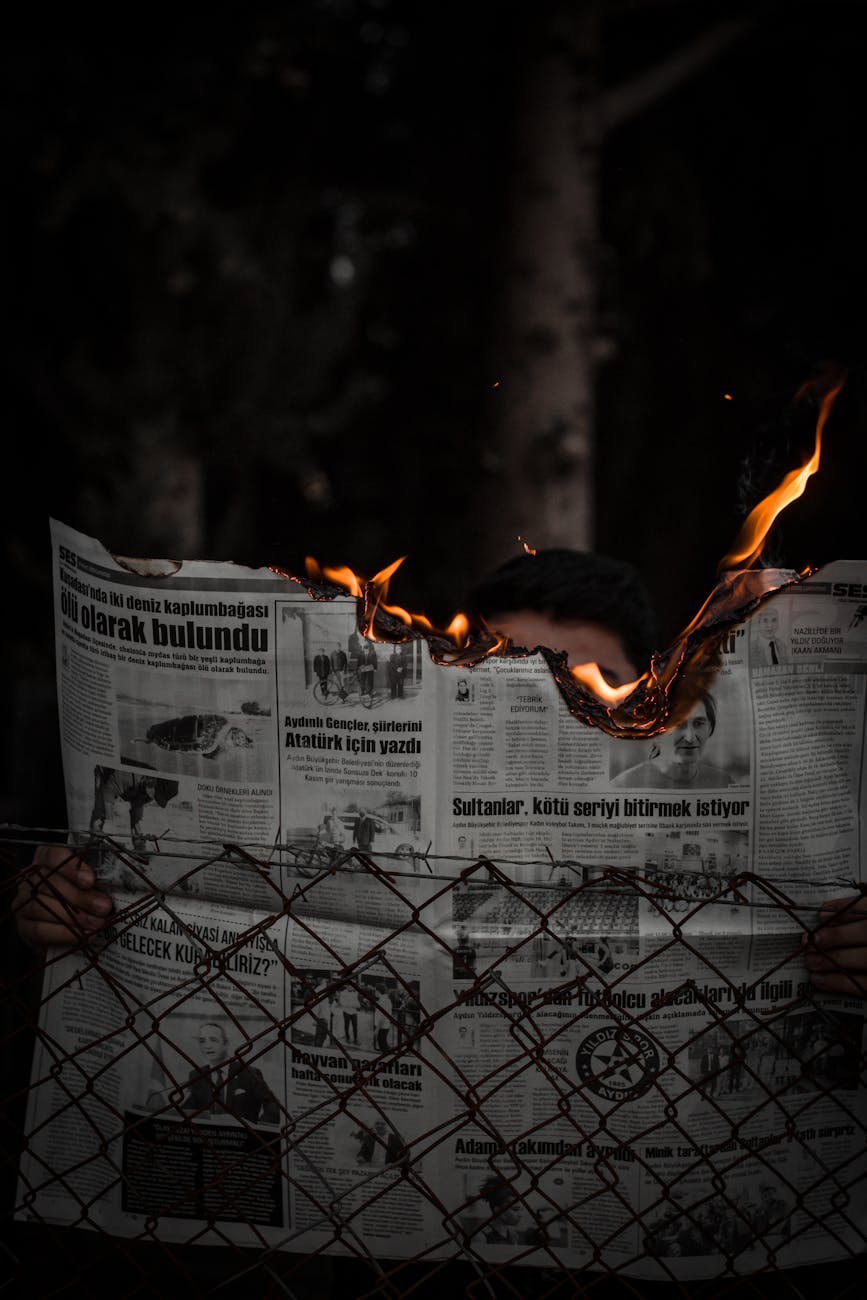
Few people have the courage to demand change in a society that tells us that there is nothing to change. Or, in the rare instances when society does accept that change might be needed, ‘you’re not the one to deliver it’, they tell us.
It’s why artists who create experimental art face so much retribution, with the unveiling of a new piece being met with, not congratulations or pride, but ‘how dare you go against the status quo.’
Society hates change.
As the root cause of censorship, noun: ‘The prohibition of anything considered obscene, politically unacceptable, or a ‘threat to security’, it is because of society’s disdain for change that our artistic freedom is violated.
Despite artists being the best people to deliver change, with change being to art what love is to poetry, (the ultimate muse), artists are all too often silenced for questioning norms (social and religious) or expressing political views that oppose the dominant narrative.
‘If you give artists freedom of expression, soon every American will want it’, the custodians of morality (men) say.
The censorship of art is all but an exertion of male authority.
And where do such remarks come from?
A place of fear.
Change threatens the place of those with power in society, hence why they are so vehemently against it…
What the people in power don’t realise, however, is that the rationale behind their opposition to art is counterintuitive to what they are trying to achieve.
When marginalised voices create art to get their voices heard in a society that demands that they move through the world in silence, silencing them via the oppression of their art only serves to justify the necessity of the arts even more. But, even so… Silenced they have been, particularly when it comes to LGBTQ+ people, women, people of colour, and anyone who questions the role of religion in society.
To focus on the former demographic, LGBTQ+ people, (lesbians in particular), while sex between consenting women is not illegal, silence is the weapon of their oppression.
In 1921, a conservative member of Parliament, Frederick Macquisten, argued that ‘Acts of Gross Indecency Between Female Persons’ should be added to the Criminal Law Amendment Act of 1885.
How can you legislate against something that is human nature?
Lesbianism, he told the House of Commons, ‘threatened the birth rate, debauched young girls, and induced neurasthenia and insanity’, and such practices, Macquisten believed, would cause contagion, for in the home of his mind, a woman’s place was on his arm and in his bed only…
While the law was never passed, Macquisten’s campaigning led to censorship laws being introduced in Britain and America that prevented lesbians from publishing anything, whether fact or fiction, about their love lives.
It wasn’t just lesbians who were subject to such discrimination, either. Straight women were also tarred with the same ‘you do not belong here’ brush…
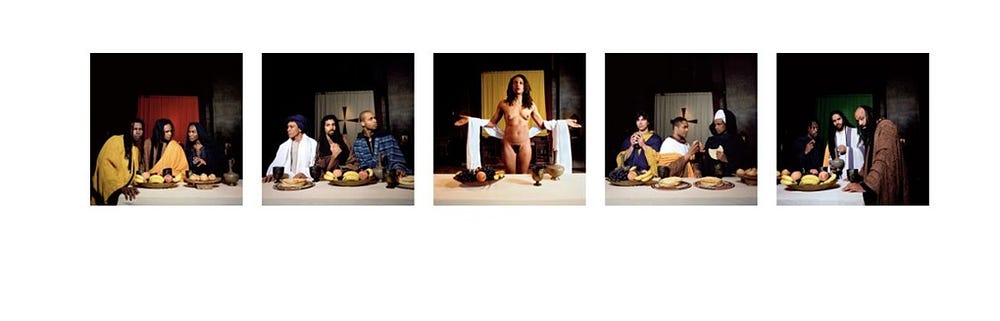
https://www.artnet.com/artists/ren%C3%A9e-cox/yo-mamas-last-supper-a-eC7x7p5WcOTQb7YIjyDUUQ2 In 1996, Jamaican American artist Renée Cox made headlines for her controversial piece of art, ‘Yo Mama’s Last Supper’ (above). The piece was a remake of Leonardo da Vinci’s “Last Supper” (1494), with a nude Cox sitting in for Jesus Christ.
Many Roman Catholics were outraged by Cox’s depiction of the Last Supper. ‘“I think what they did is disgusting, it’s outrageous,” the former associate attorney general of the United States, Mayor Rudy Giuliani, said.
In response to her critics? ‘Get over it!’ was all Cox had to say. ‘Why can’t a woman be Christ? We are the givers of life!’
Unfortunately, though, what is anatomically provable (woman birthed man), is wrongly said to be disprovable by what is nothing more than a fairytale (man birthed woman from his rib) …
The 19th-century French painter Gustave Courbet also caused controversy from a patriarchal perspective with his painting titled ‘Origin of the World’ (1866).

https://www.flickr.com/photos/terrykoh/3395011209 The close-up depiction of the genitals and abdomen of a female nude lying on a bed with her legs spread has long been a subject of obscenity laws, with some feminists arguing that the painting is a powerful symbol of female sexuality and liberation, while others see it as objectifying and degrading.
The same is true of Robert Mapplethorpe’s photography, too, whose work is deemed at once both liberating and degrading…
Is it outrageous, or is it a truthful exploration of the human body, sexuality and desire?…
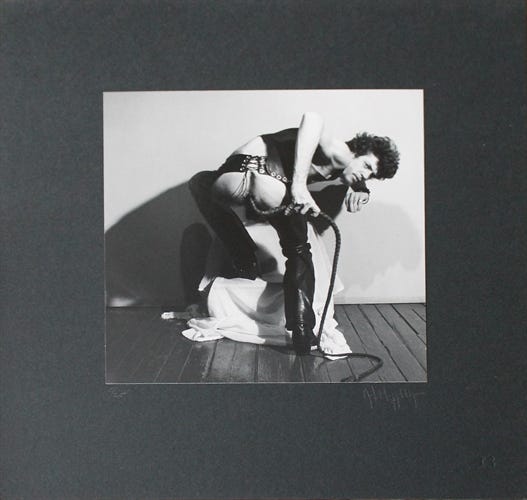
https://www.artnet.com/auctions/artists/robert-mapplethorpe/self-portrait-with-whip-from-the-x-portfolio In the 80s, Robert Mapplethorpe’s photographic scenes of sexual domination and bondage caused a stir in the art world.
In his photographs, Mapplethorpe was portraying, not only gay sex, which was a taboo in itself, but sadomasochist gay sex, to intentionally provoke a prudish America.
Among his most controversial works, there was a self-portrait within which Mapplethorpe had a bullwhip in his anus, as well as photos that he had taken of his friends. There are many, too many to list here, but two that spring to mind are titled, ‘Fist Fuck / Full Body’, which is a photograph of a man elbow deep in another man’s anus, and ‘Jim and Tom, Sausalito’, which is a photograph of a man (Jim) urinating in another man’s mouth (Tom).
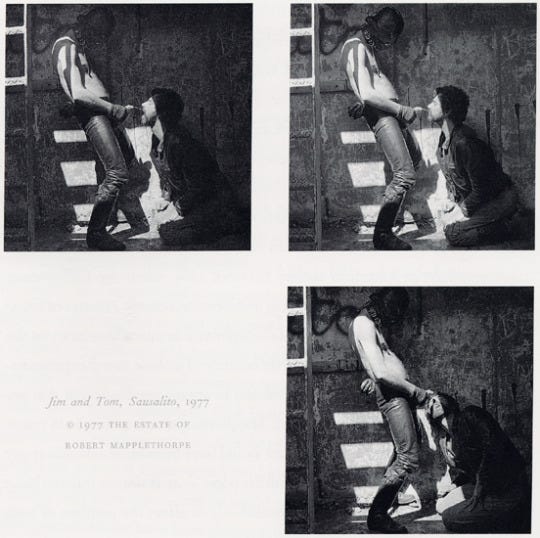
https://www.tumblr.com/categorized-art-collection/59014549792/robert-mapplethorpe-jim-and-tom-sausalito Arts ability to shock in ways that create long-lasting impacts on audiences is a testament to the power that it holds in society.
So shocking to the public were Mapplethorpe’s photos that displaying them led to one museum being taken to court on criminal charges for the first time ever as a direct result…
Fortunately, jurors decided in the museum’s favour, agreeing that art doesn’t have to be pretty or ‘nice to look at’ for it to be of value, but the fact that people are still scared to write about certain topics, or paint certain subjects, or take photographs that depict certain things today is proof that there is still work that must be done to ensure that artists are granted the permission to be just that… artists.

https://www.thetimes.com/article/tracey-emin-my-bed-marriage-and-moving-back-to-margate-ttp08t6ds Unfortunately, someone who didn’t quite pass the obscenity check like Robert Mapplethorpe was the author of Ulysses, James Joyce.
Ulysses was first published in 1918 in a small magazine called The Little Review. However, due to the sexual content and blasphemous language within the book, it wasn’t long before it was banned in English-speaking countries around the world, and The Little Review’s Editors, Margaret Anderson and Jane Heap, were tried under obscenity.

https://blogs.lib.ku.edu/spencer/tag/the-little-review/ ‘It sounds to me like the ravings of a disordered mind — I can’t see why anyone would want to publish it’, one judge said of Ulysses, the assumption being that its characters would lead women down a path of ever-expanding permission ending in broken families and a ruined nation.
Exploring sexual pleasure outside marriage could lead to questions about the wisdom of marriage and monogamy itself, which opened the door to questioning all unexamined pieties, including nationalism, capitalism, and religion.
As such, Anderson and Heap were found guilty, fined, and ordered to cease publication.
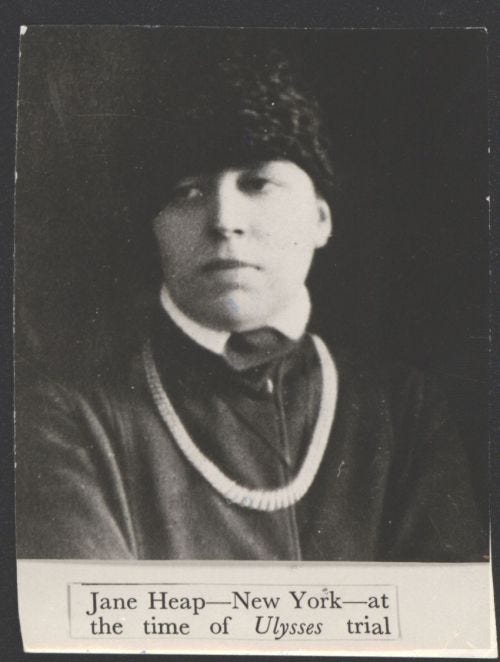
https://uwmarchives.tumblr.com/post/650456589646561280 For many readers, as well as Joyce’s literary contemporaries, the idea that Joyce’s experimental work had been banned as obscene was absurd. For many legislators, journalists, and other readers, however, the book was pornographic and blasphemous.
Alas, if art is to be successful, it must reflect the world in its entirety, including the so-called ‘distasteful and obscene’ aspects.
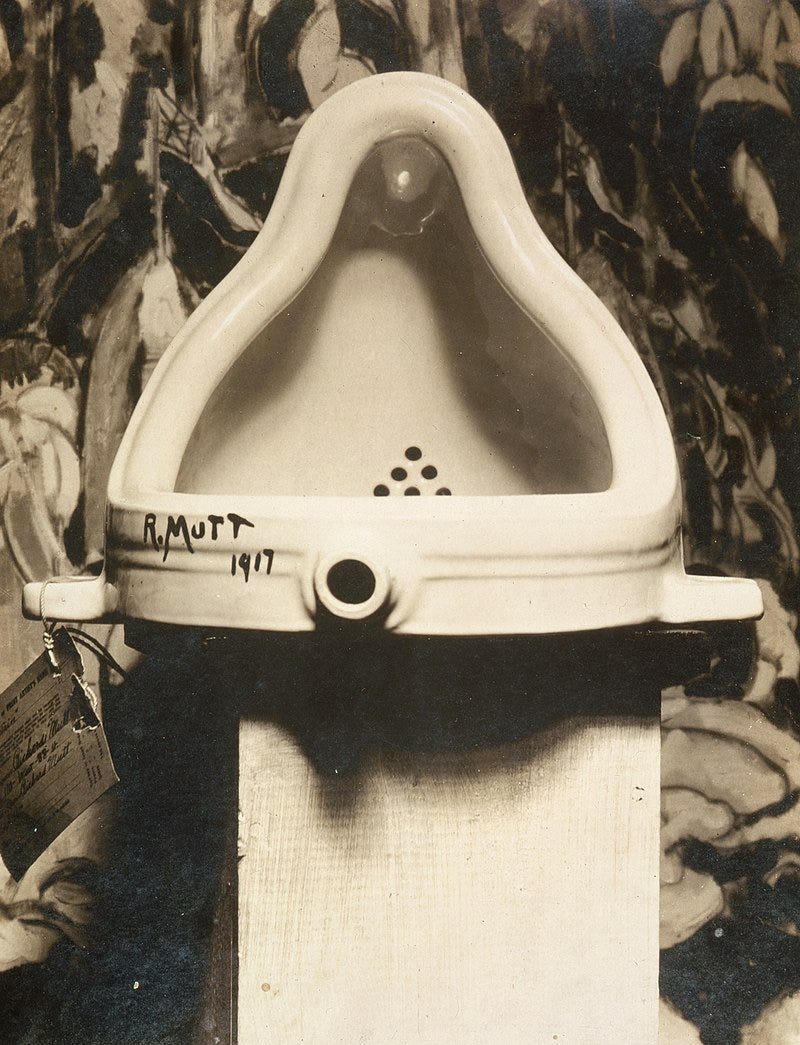
https://boynesartistaward.com/best-tips-tools-for-emerging-artists/10-controversial-artworks-that-shook-the-art-world To ban art is to ban humanity.
One cannot be an authentic artist under fear of censorship, for censorship is the antithesis of the freedom of expression that is art.
-
Is The Bible A Fairytale?

Genesis: The Rewritten Story
Will Your Idle Talk Reduce Men To Silence? (Job 11:3)
Reconstructing the fairytale for adults who fear the unknown
In the beginning, the Earth was formless and empty, with a blanket of darkness covering its surface until God* said, ‘Let there be light…’
And there was light.
*(God = the first physical presence in the ever-present spiritual realm, and the creator of heaven and earth).
When he passes me, I cannot see him; when he goes by, I cannot perceive him. He is before all things, and in him all things hold together.
Photo by Dyu – Ha on Unsplash God saw that the light was good, so he separated the light from the darkness. God called the light ‘day’ and the darkness he called ‘night.’
And God separated the water from under the expanse from the water above it. God called the expanse ‘sky’, and God said, ‘Let the water under the sky be gathered to one place, and let the dry ground appear.’
And it was so.
God called the dry ground ‘land’, and the gathered waters he called ‘seas.’ And God saw that it was good.
And it was so.
And it was so.
And it was so.And God saw that it was good.
And God saw that it was good.
And God saw that it was good.Then God said, ‘let us make man in our image, in our likeness, and let him rule over the fish of the sea and the birds of the air, over all the earth, and over all the creatures that move along the ground.’
Genesis 9:3: ‘Everything that lives and moves will be food for you. Just as God gave you the green plants, I now give you everything.’
And there came the downfall of humanity, over before it had even started…
Photo by Museums Victoria on Unsplash Colossians 1:15: ‘He is the image of the invisible God, the firstborn over all creation.’
God formed man from the dust of the ground and breathed into his nostrils the breath of life.
I am the alpha and the omega, the first and the last, the beginning and the end.
Except man didn’t arise the from the dust of the ground but from the matter of the universe… From stardust…
Photo by Jametlene Reskp on Unsplash The Bible is all but a metaphor for our existence that has been simplified into human terms, and turned into a fairytale…
Genesis 15:5: ‘Look up at the heavens and count the stars, if indeed you can count them. The sun and moon and stars were bowing down to me.’
A fairytale that at once uses false promises, ‘he is good; his love endures forever’, and fear, ‘eat the forbidden fruit and you will become more ego (human), and less soul (spirit)’, to force people to conform…
Photo by Andy Bodemer on Unsplash Eating from the Tree of Knowledge is a metaphor for our transition out of a state of pure consciousness, (the state we were in before we were born into this world and the state that we will return to one day when our soul leaves our body), into consciousness.
I am with you and will watch over you wherever you go, and I will bring you back to this land.
Trying to comprehend the incomprehensible, is this a metaphor for reincarnation, the process of being reborn until we become enlightened and reach nirvana, a concept that can be found within the oldest (and most plausible) religion, Hinduism?
Alas, what is the bible if not just an adaptation of Hindu scripture?…
Photo by Chad Greiter on Unsplash The concept of reincarnation has merely been adapted in the bible to replace the traditional spiritual language found in the Vedas with a language better understood by humans…
Because you listened to your wife and ate from the tree about which I commanded you, ‘you must not eat of it’, cursed is the ground because of you; through painful toil, you will eat of it all the days of your life. It will produce thorns and thistles for you, and you will eat the plants of the field. You will eat your food by the sweat of your brow until you return to the ground. Since from it, you were taken; for dust you are and to dust you will return.
Why does the bible revert to fearmongering to scare people into submission?
Photo by Joshua Davis on Unsplash Leviticus 18:22: ‘Do not lie with a man as one lies with a woman; that is detestable.’
Leviticus 19:27: ‘Do not cut the hair at the side of your head or clip off the edges of your beard.’
‘You are free to eat from any tree in the garden, but you must not eat from the tree of knowledge…’
Can’t you see that it’s all about control?
‘Know for certain that your descendants will be strangers in a country not their own, and they will be enslaved and mistreated for four hundred years, but I will punish the nation they serve as slaves, and afterward, they will come out with great possessions.’
Photo by Dimmis Vart on Unsplash ‘… Here comes the dreamer…’
Genesis 19:9: ‘I have now seen the one who sees me. This fellow came here as an alien, and now he wants to play the judge!’
Photo by Siim Lukka on Unsplash Wake up, O sleeper, rise from the dead.
Sin is crouching at your door (and the sin is religion)… It desires to have you, but you must master it.
Don’t allow yourself to become just another restless wanderer of the earth.
-
Depictions Of Diet Culture In The Devil Wears Prada
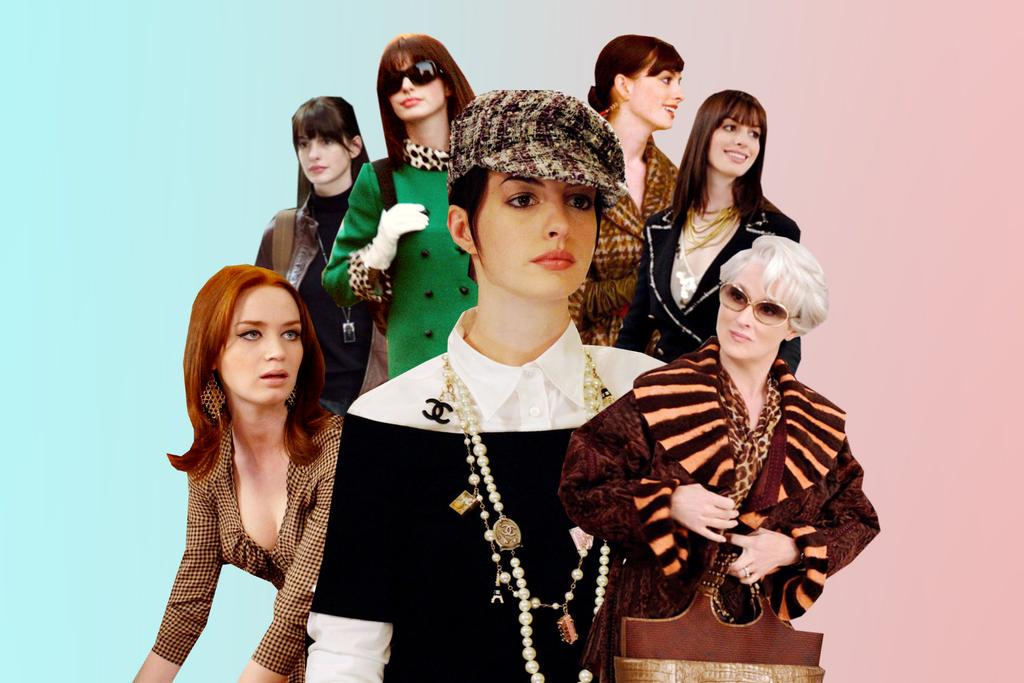
Hitting the big screen during the height of the ‘Does my bum look big in this?’ epidemic, The Devil Wears Prada was released in 2006 as an adaptation of Lauren Weisberger’s debut novel of the same name.
The blockbuster film starring Meryl Streep and Anne Hathaway quickly gained a cult following owing to its relatable (and troubling, though this aspect is often overlooked) depiction of womanhood.
In recent months, The Devil Wears Prada has also been adapted for the stage and is currently running in London’s Westend at the Dominion Theatre under a creative team led by no other than Sir Elton John.
I took a trip there yesterday with my Mum to see what it was all about.
So, what is it all about?…
https://www.tvinsider.com/show/the-devil-wears-prada/ The Devil Wears Prada takes audiences behind the scenes of the cut-throat fashion industry, following the journey of a young aspiring journalist, Andy Sachs, who lands a job as the assistant to the formidable editor-in-chief of a prestigious fashion magazine, Miranda Priestly.
A weird mix of feminism and, well, anti-feminism, on the one hand, The Devil Wears Prada has proven to be one of the greatest depictions of female empowerment around, through which the lead character, Miranda Priestley, is someone to whom everyone bows down. The power is all hers. On the other hand, however, the film serves to uphold harmful stereotypes relating to a woman’s place in society…
Know your place.

https://dragonspiritnews.org/2356/news/we-need-to-talk-about-diet-culture/ Makeup and diets, cosmetics and designer handbags, shoes and clothes are sold to and bought by women for the sole purpose of boosting the very thing that is responsible for humanity’s downfall, the ego. In this respect, the Devil doesn’t wear Prada so much as the Devil is Prada.
But who are you?…
https://www.mcgilldaily.com/2019/02/dismantling-diet-culture/#close-modal We all put a mask on, some of us more than others. Presenting to the world as a ‘better’, more enhanced version of ourselves, we cover up our spots with concealer and airbrush our cellulite away, turning ourselves into someone else at the click of a button.
Letting unsuspecting minds remain unsuspecting, ‘This is me, unedited’, we tell the world, believing that our worth can be sought from the opinion of strangers.
‘How many likes did you get on your recent, though? That’s the real measure of your happiness.’
If your happiness is measured based on how popular you are in the eyes of people you’ve never even met, then it’s superficial, for the real measures of happiness are based on who you are as a person, not on how well you can be a depiction of the ‘perfect’ model of capitalism.

https://www.buzzfeed.com/samstryker/devil-wears-prada-sick-burns With the weight of the world resting on your shoulders and no way to lessen the load, some people are pushed to breaking point.
Unlike men whose suitability for a job is judged on their qualifications and ability to perform the job role, and asking what they will change as the new face of the company is done in a purely professional capacity, a woman’s suitability is determined more so on what she looks like, with the ‘new face’ of the company a question to be taken literally. ‘We want you to adopt a new face.’
Why is the value she holds determined by the value he places on her body?…
https://www.istockphoto.com/illustrations/rape-victims-cartoon For a film about the unrealistic beauty standards that are imposed upon women, ‘The Devil Wears Prada’ is an apt name.
Discussing themes relating to the unrealistic expectations that are put on women throughout, the film explores very well the pressure that the fashion world imposes upon all those who are a part of it. What it fails to do, however, is seek to correct the narrative that is pushed on us all regarding thinness equalling success…
While written with a humorous intent to make the audience laugh, without risking being called a ‘snowflake’ here, I couldn’t help but feel slightly uncomfortable by the references made towards unhealthy (undoubtedly), and disordered (highly probably) eating habits.
The fact is that to talk about not eating as a joke, or if you’re feeling weak, eating a cube of cheese, ‘I’m just one stomach flu away from my goal weight’, is dangerous, not least insensitive to anyone who has had an eating disorder and understands the perils that it entails.

https://toledocenter.com/resources/7-hidden-signs-of-eating-disorders/ ‘I told myself, take a chance, hire the smart, fat girl’, Miranda said of her new assistant, Andy. Andy is played by the, already slim, Anne Hathaway. I can’t help but question how Hathaway must have felt reading through the script knowing that she was cast as the ‘fat’ girl.
Whether said as a ‘joke’ or not, we shouldn’t be doing anything that can be (mis)interpreted as being an attempt to glamourise eating disorders, when eating disorders are the deadliest psychiatric illness in the world (Anorexia Nervosa claims the lives of one in four of sufferers who are not in treatment) …
By all means, talk about diet culture and unrealistic body expectations in women, because don’t we all know that they exist, but do so in a way that doesn’t contribute to the continued oppression of women.
Have the underlying moral of the story be about why size doesn’t matter and, while doing so, think about how much money you could save if you stopped handing over your wages to the people whose solutions are destined to fail…
Stop letting them profit from your self-loathing.

https://getfitwithashley.com/transform-your-life-diets-dont-work/ If diets worked, the diet industry (in the UK alone) wouldn’t be raking in $2 billion a year, for Slimming World and the like would all cease to be in business.
The reason why diets don’t work is because they are designed to be that way by power-hungry men, the same men who are responsible for designing every billboard that tells us who we should be. They profit from our self-loathing and then berate us for being self-obsessed*.
*(Yes, we are ‘self-obsessed’, although not because we’re narcissistic, but because there’s no room for us to think about anything else. Society has made us this way)…

https://www.istockphoto.com/illustrations/patriarchy Alas, a woman who spends her days obsessing about the way she looks is one less woman obsessing about changing the world. She is one less threat to the system.
In other words, keep women subdued and the patriarchy will prevail.
What next for The Devil Wears Prada?
With a sequel reportedly in the works at Disney which is set to focus on the decline of printed magazines in line with our current times, one can only hope that the producers will also get in line with our current times in terms of shifting the narrative surrounding female expectations, too.
-
What Does The Ceasefire Deal Mean For Palestine?

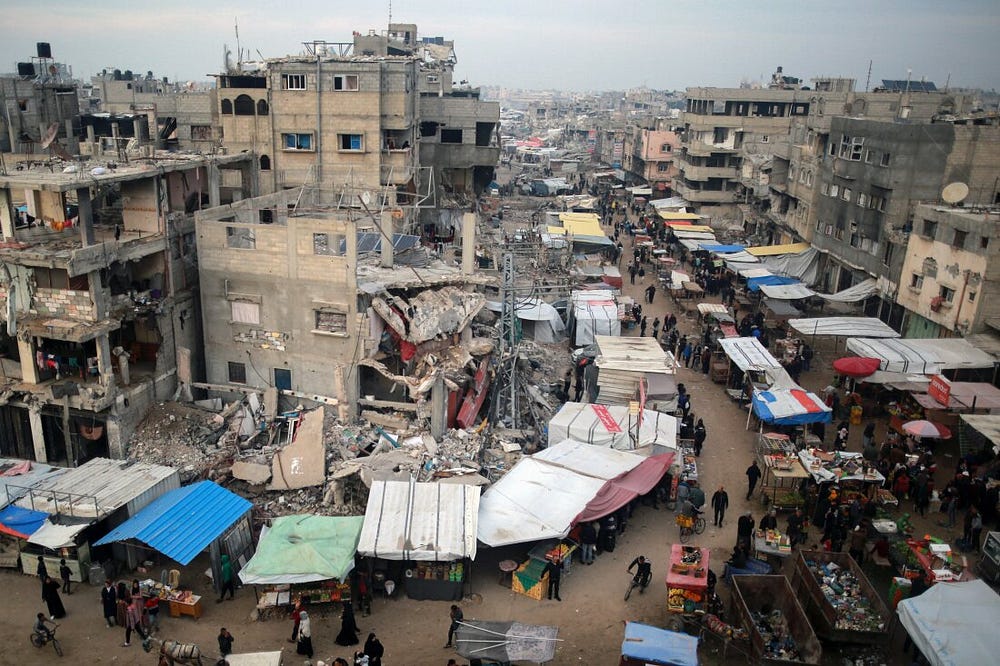
Since Hamas invaded Israel in October 2023, and Israel subsequently retaliated by launching a bloody attack in Gaza, over 46,000 Palestinians have been killed and over 109,000 wounded.
Women and children make up half of this death toll.
There have been calls for a ceasefire since the war began, with people going out in their droves armed with handmade signs and microphones demanding that our world leaders do something.

https://socialistworker.co.uk/palestine-2023/palestine-march-london-3/ On Saturday the 11th of November 2023, records were broken when over one million protestors flooded the streets of London to stand in solidarity with the people of Palestine and demand a ceasefire, (an end to the fighting, or at the very least a pause to allow innocent civilians to escape), but all to no avail.
The fighting continued.
Lives kept being lost.
Yesterday, however, on Wednesday the 16th of January, we got a glimpse of hope when Israel’s Prime Minister, Benjamin Netanyahu, announced that there would be a ceasefire this Sunday (19/01/25).
While this is of course a welcome relief, the worry is what exactly the ceasefire will entail…
In other words, is it an end to the war, in which case families can be reunited and the fear of death that lingers in the air can be overcome, finally, or is it simply just another temporary pause until the Israeli army starts firing bullets into Gaza again?
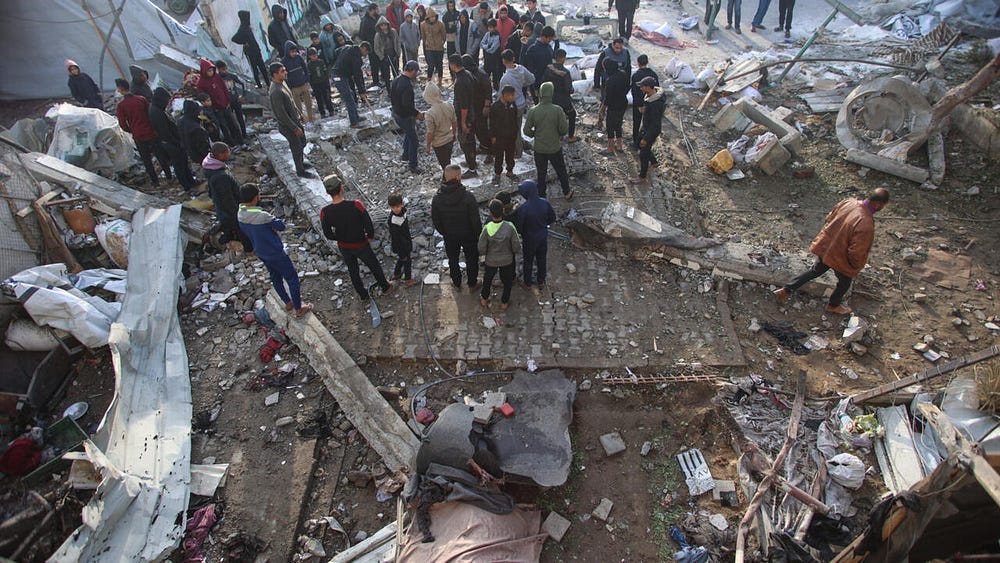
https://www.france24.com/en/live-news/20250115-gaza-rescuers-say-israeli-strikes-kill-24-palestinians Before we can celebrate the end of this bloodshed, we first need to make sure that this will indeed be the end of this bloodshed…
Is it the end?…
Israel and Hamas have agreed a ceasefire to halt* the 15-month war in Gaza and free the remaining hostages, mediators have said. What they have not said, however, is whether or not the war is over.
*Note the word ‘halt’ (noun): ‘A suspension of movement or activity, typically a temporary one.’
https://www.npr.org/2025/01/15/g-s1-42883/ceasefire-israel-hamas-gaza-hostage-release How would the ceasefire work, exactly?
The ceasefire is expected to happen in three stages.
Stage 1: The first stage would last six weeks and see “a full and complete ceasefire”. This would include the release of hostages in Gaza and Palestinian prisoners in Israel. Gazans who have been displaced would be allowed to start returning home, and a number of hostages held by Hamas would be released in exchange for hundreds of Palestinian prisoners.
During this stage, Israeli troops would pull out of all populated areas of Gaza, thus allowing Palestinians to return to their neighbourhoods.
There would also be a surge in humanitarian aid deliveries to Gaza during stage one of the deal.
Stage 2: The second stage would signify a permanent end to the war. There would be a full withdrawal of Israeli troops from Gaza, and the remaining hostages would be released in return for more Palestinian prisoners.
Stage 3: The third and final stage would involve the reconstruction of Gaza — something which could take years — and the return of any remaining hostages’ bodies.
The priority now must be to ‘ease the tremendous suffering caused by this conflict’, officials say.
So, why is the suffering continuing?

https://www.usnews.com/news/world/articles/2024-08-09/israel-strike-on-gaza-school-kills-more-than-100-palestinian-news-agency-says Unfortunately, just a few hours after the ceasefire deal was announced to the international press, dozens of Palestinians were killed in Israeli strikes.
The dead reportedly include 21 children and 24 women.
“It was a bloody night,” Dr Eliwah said, over the phone from Gaza City. “We did not rest for one minute. The injured kept on coming. The dead we sent directly to the morgue.”
Alas, ‘happy, but not breathing’ is the sentiment in Gaza at the moment, for until there is proof that the war has ended, freedom will never be.
Photo by chris robert on Unsplash -
The Forgotten History of Berlin
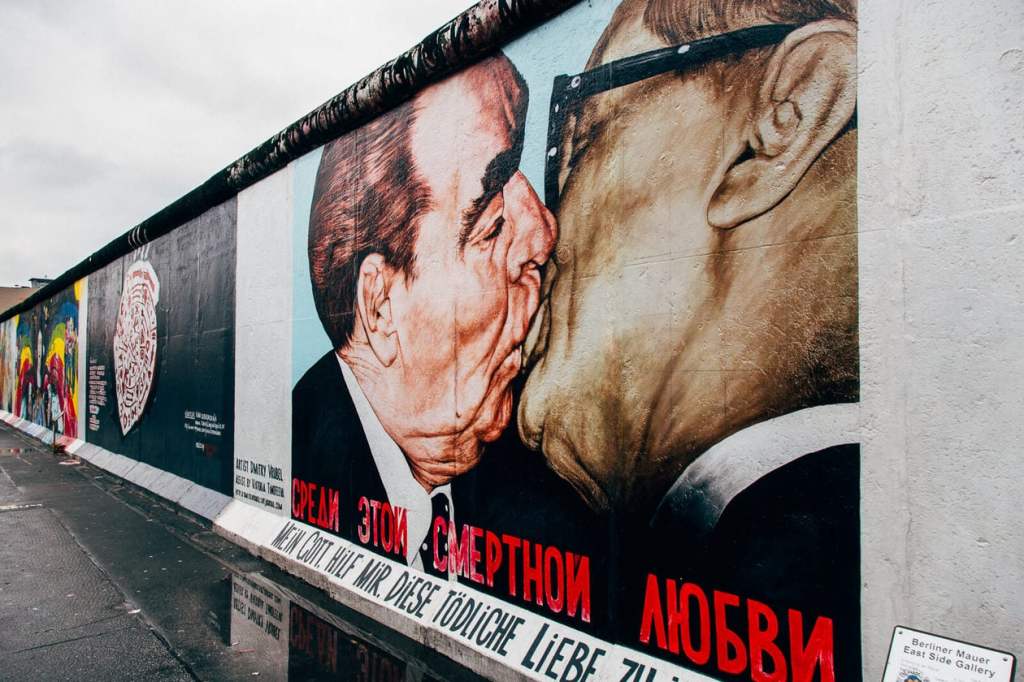
My partner and I are both interested in art and history and, as lesbians, we love to delve into queer history in particular. Berlin offers tourists an unrivalled opportunity to experience queer history, in all its glory…
Armed with a burning curiosity and an eagerness to discover all that the bustling city had to offer, we arrived in the German capital at the fall of dusk on Friday the 15th of November 2024.
The journey from the UK was a short one. It took just two hours for us to get from Birmingham airport to Brandenburg, and from there, half an hour in an Uber to get to our hotel.
While there are hundreds of places to stay in the German capital, we chose the Arte Luise Arthotel based on its description of being an ‘art gallery to stay in overnight.’
For the next three nights, we took residence in room 206, the ‘Cabaret’ room.
Red velvet and brocade, the bed draped with lace and exposed on a pedestal, with red lights, erotic dancers and the sounds of the old Paris-Moscow trains carry the guest back in time to the atmosphere of the establishments of the 1920s and the old Berlin of Christopher Isherwood*.
*Isherwood’s best-known work is Goodbye to Berlin (1939), a semi-autobiographical novel which inspired the musical Cabaret (1966).
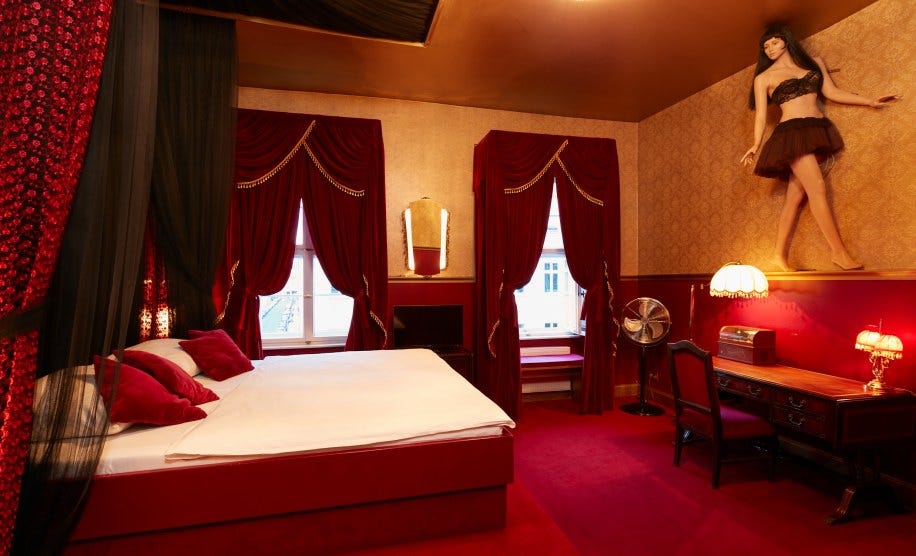
https://www.luise-berlin.com/en/rooms/double-room-with-showerwc/206-cabaret A fitting tribute, one could say, for where we were to venture to the next day.
But first, the important stuff…
Whilst in Berlin, we both felt that it was important, no matter how upsetting it might be, to visit the Memorial to the Murdered Jews of Europe.
An installation designed by architect Peter Eisenman and Buro Happold, the memorial, as pictured below, is a work of art in itself.
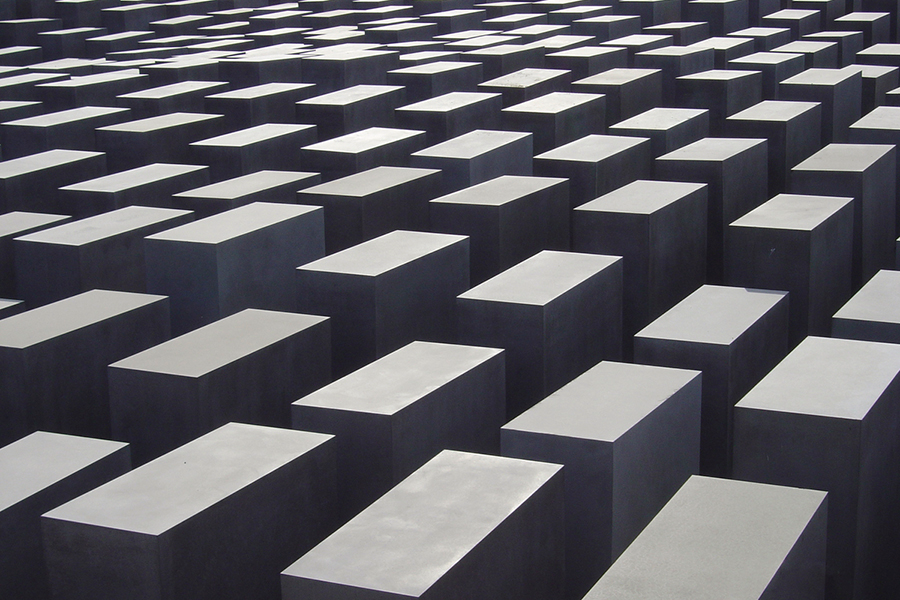
https://www.theolinstudio.com/memorial-to-the-murdered-jews-of-europe Eisenman placed 2711 concrete stelae of different heights on a site covering 19,000 square metres. Its openness and abstractness gives visitors space to confront the topic in their own personal way.
It represents whatever you think it represents. That is the beauty of it.
We also visited the Sachsenhausen concentration camp while we were in Berlin where, in the years between 1936 to 1945, more than 200,000 people were interned.
Those targeted included political opponents of the Nazi regime, members of groups declared by the Nazis to be racially or biologically inferior, such as Jews, Roma and other people derogatorily labelled as ‘Gypsies’, people persecuted as homosexuals, as well as social outsiders who were labelled as ‘antisocials’ and ‘career criminals’.

https://www.getyourguide.com/oranienburg-l151147/from-berlin-private-sachsenhausen-concentration-camp-tour-t314567/ Located in what very much felt like ‘the middle of nowhere’, (it was, in fact, just North of Berlin), we had to catch a train from Hauptbahnhof (Berlin Central Station) to Oranienburg, and from there a connecting train to Sachsenhausen to get to the concentration camp. The journey was approximately 25 miles, and it took just shy of an hour.
We got there an hour before closing time, as dusk was setting and the rain was just beginning to pour down, and it made the experience even more emotional.
Walking around the grounds in what we considered ‘grim’ conditions (a bit of cold and rain), made us realise what those 200,000 prisoners must have felt.
The awareness that this was their life, but unimaginably worse, is hard to rationalise when you live in a free world.
It’s hard to rationalise, with the freedom that we have today, that even after the war, when the Nazis had been defeated and the concentration camps closed, that there would still be so much division in Berlin, the oppression of the Nazi regime being replaced with the oppression of the SSSR.
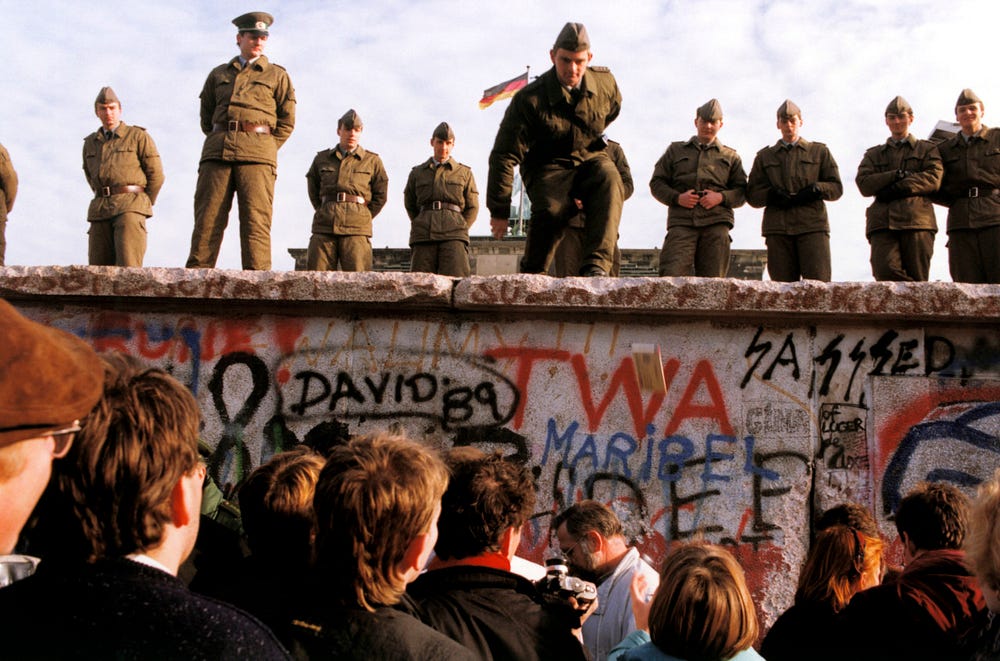
https://www.magnumphotos.com/newsroom/fall-of-the-berlin-wall/ Post second world war, when Germany had surrendered, Berlin became occupied by several different (and opposing) forces, with the Soviet Union occupying the East under a communist state, and the US, the UK, and France occupying the West under a capitalist democracy.
Unsurprisingly, people in the East wanted to escape to the West, and so in 1961, a wall was built to divide the city into two halves.
The 27-mile-long stretch of concrete running through the city was comprised of two parallel walls punctuated with guard towers and separated by the “death strip,” which included guard dogs, landmines, barbed wire, and various obstacles designed to prevent escape. East German soldiers monitored the barriers 24/7, conducted surveillance on West Berlin, and had shoot-to-kill orders should they spot an escapee.
In 1989, however, on November the 9th, five days after half a million people gathered in East Berlin in a mass protest, the barrier that had divided Berlin and ripped families apart for 28 years finally came toppling down.
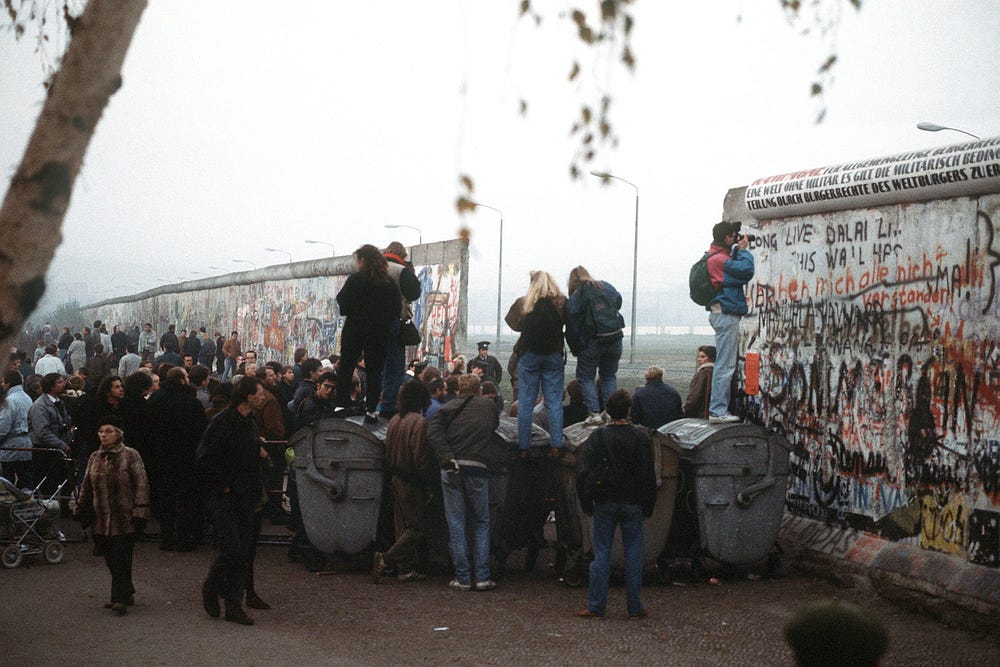
https://unwritten-record.blogs.archives.gov/2019/11/07/the-berlin-wall-30-years-after-the-fall/ With the collapse of the Berlin wall came freedom, and with freedom, art.
Welcome: East Side Gallery.
Today, what remains of the Berlin wall is home to more than 100 murals, painted by artists from all over the world, thus making it the largest open-air art gallery in the world, and the finest example of how art and activism can combine.
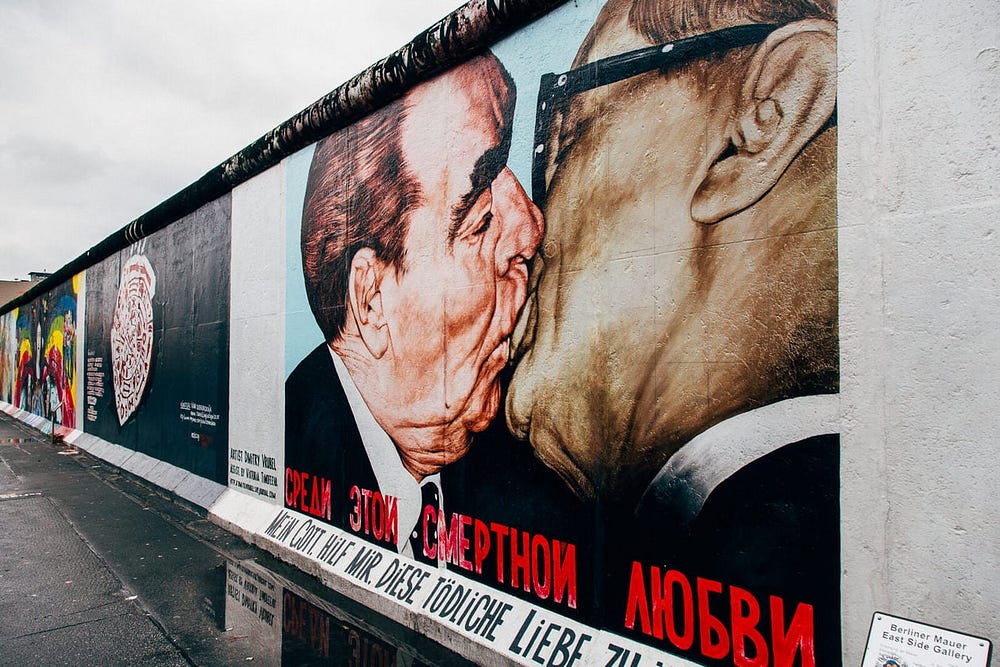
https://hellojetlag.com/east-side-gallery-berlin-wall/ Splashing politically charged messages across Cold War barriers; the illegal status of graffiti only served to add to the political statement that the artists were trying to make.
‘What happens when freedom limiting laws are imposed? We break them’…
This is a sentiment that brings me nicely onto the final destination in our whirlwind weekend trip to Berlin, the KitKat Club…
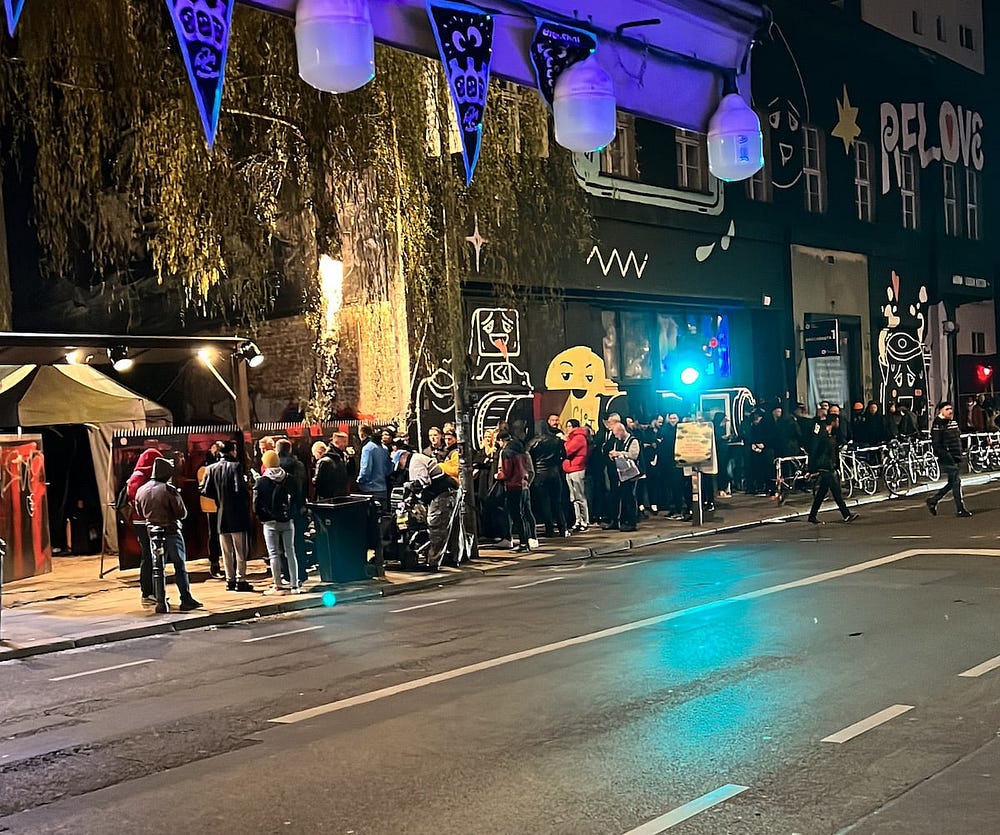
https://thefabryk.com/blog/a-night-at-kitkat-in-berlin If Weatherspoon’s is your go to pub and you squirm at the mention of sex, then the KitKat Club is probably (definitely) not for you. But before we get into all that, first, the history…
What is the KitKat Club, exactly?…
‘KitKat Club’ was the name given to the infamous gay nightclub in Cabaret, a musical based on Christopher Isherwood, an American novelist and playwright’s novel, Goodbye to Berlin.
Goodbye to Berlin, although fictional, is very factual in its storytelling of a city under attack.
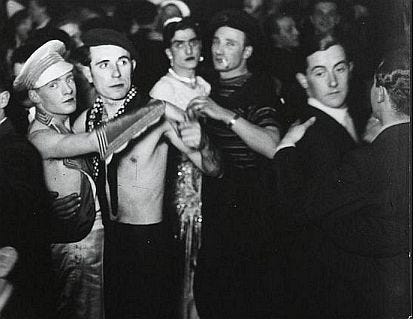
https://www.reddit.com/r/TheWayWeWere/comments/ue68qo/the_eldorado_was_a_famed_destination_in_berlin/ Isherwood’s writing largely mirrors his own experiences as a gay man who fled to Berlin at the age of 25 to find sexual freedom amongst the plethora of gay bars, such as The Eldorado, that the city had to offer.
The same sense of liberation and freedom that was sought in the clubs of twentieth century Berlin, as portrayed in ‘Goodbye to Berlin’ and Cabaret, can still be sought in the real-life KitKat Club of today….
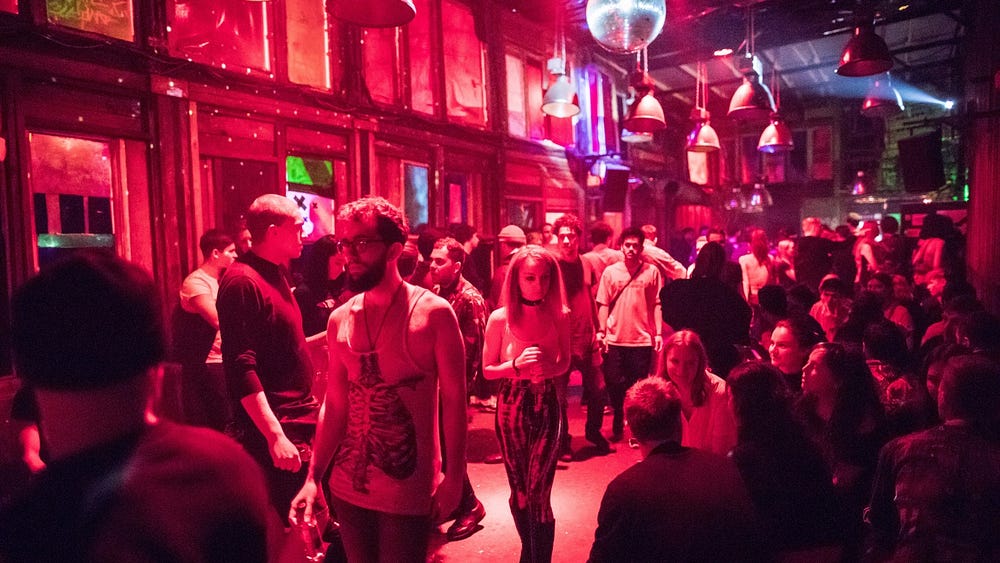
https://www.irishtimes.com/news/world/europe/berlin-s-vanishing-nightclubs-the-open-sex-in-all-corners-can-be-distracting-1.4152966 Opened in 1994 by Austrian pornographic filmmaker Simon Thaur and his partner, Kristen Kruger, with a vehement sex positive attitude where patrons are allowed to engage in sexual intercourse openly, a visit to the KitKat Club is quite the experience.
To get in, remember the ‘undress’ code. If you turn up as a single man wearing jeans, a t-shirt, and a pair of trainers, you will be turned away by the two bouncers who stand at the door.
Less is more.
Once in, you can strip down even further, if that’s your thing. You wouldn’t be alone in walking around stark naked, in fact. Any bags or items of clothing that you want to shed can be stored alongside your phone (phones are not allowed on your person for obvious reasons, as the topless women behind the bar will tell you), to be collected at the end. And then… It’s time to explore!
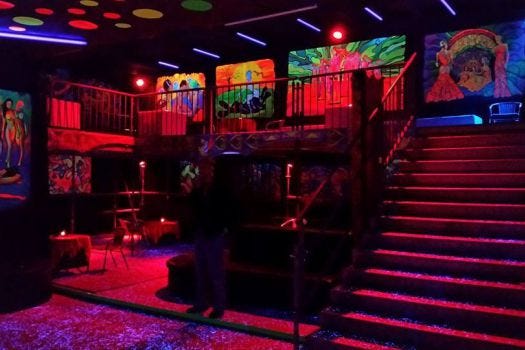
https://www.ellgeebe.com/en/destinations/europe/germany/berlin/nightlife/kitkat-club Within KitKat Club there are several rooms to explore, accessible only by pushing through a crowd of sweaty bodies dancing to techno.
When the KitKat Club is more than just a nightclub, but a cultural institution, I, for one, wanted to experience all of it…
After adjusting to the environment that was unlike anything we had ever seen before, we made our way around the three-storey building, entering the dark room before being abruptly told to shut the door. ‘Nothing can happen when the door is open.’ I’m still a bit lost on the purpose of the dark room, if I’m honest… With sex going on in every room, what is its purpose, exactly?
Does the woman bent over with a guy’s penis sliding in and out of her mouth know him, or have they just met tonight? Who knows… Onto another room.
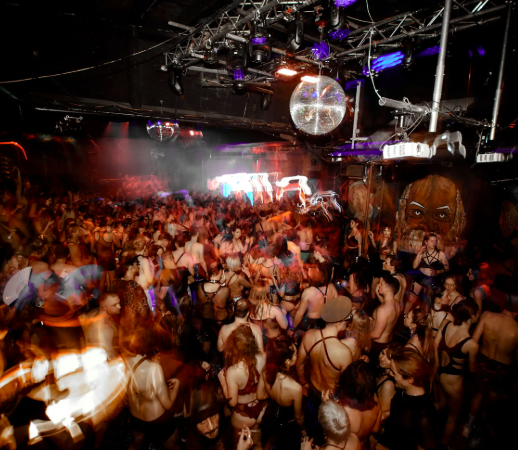
https://ra.co/events/1604186 We carried on looking around, and unbeknown to me at the time, we entered a room that made everything glow in the dark. In it, there was a man who kept smiling at me, his teeth glowing in the dark. Because I was slightly (okay, maybe very) intoxicated at this point and had no idea what was happening, it scared me, and he must have been able to tell. ‘Are you afraid?’, he asked, and If I wasn’t afraid before then I was then… We left that room and went back downstairs to join the mass of sweaty bodies dancing. I can remember my girlfriend tapping me on my shoulder and looking up to see a woman being fucked over the railings upstairs.
Can you see why phones aren’t allowed now?…
What is allowed, however, is voyeurism, and in a venue where sex is essentially a (consensual) free for all, it’s to be expected.
In other words, you can’t venture into the KitKat Club and get mad when you stop kissing your girlfriend and see several men stood behind you wanking off like you’re there to put on a show for them. If the thought of that makes you want to vom, then I’d suggest that you give it a miss and stick to the trusted ‘spoons instead…
Go with a free spirit and an open mind, however, and you will see the best of Berlin. In every sense.
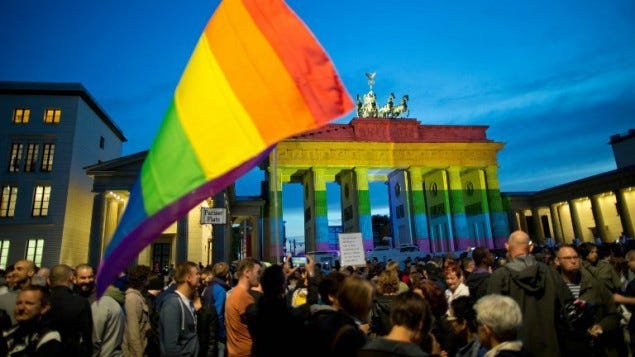
https://pikabu.ru/story/berlin__raduzhnyiy_gorod_4965253 Would I go back?
With so many countries to see in the world, and so little time (and money) to visit them all, I’m usually a ‘once is enough’ type of person when it comes to travelling. With Berlin, however, and the amount of culture and history it has on offer, I would love to go back and do it all over again.
In the meantime, though, onto our next destination as I travel the world with the love of my life…
Photo by Léonard Cotte on Unsplash -
The Price Of Everything. The Value Of Nothing

Too many of us conflate the price of something with the value of something, forgetting that the two have vastly different meanings.
When happiness is dependent on how well our physiological needs are met, it is the most basic things in life, such as getting enough sleep, exercising regularly, and eating a healthy, well-balanced diet that make us the happiest, yet far too many of us sacrifice these things in pursuit of what we think will bring us happiness.
It’s not ‘self-care’ when you’re starving one thing to feed another, neglecting the soul’s needs to prioritise the ego’s wants.
Photo by Annie Spratt on Unsplash We sit at our desks, our eyes glued to a computer screen until 4 am because we believe the lies that capitalism has fed us about money being ‘everything.’ Living on fast food because we’re too busy working/we ‘don’t have time to cook’, we starve our soul so that we can feed our ego, thinking, ‘If only I could make more money, then I would finally be happy.’
Why?
Because it’s what capitalism has taught us.
Money cannot and does not buy happiness, but it does allow you the freedom to choose your own form of misery.
Photo by Austin Poon on Unsplash Capitalism has taught us to prioritise profit over everything. It’s why people spend most of their waking hours at work in a desperate pursuit to reach the ever-elusive state of happiness.
We mark the days off on a calendar like we’re inmates in prison serving a whole life order, counting down the hours until it’s 5 pm and we can log out, counting down the years until we’re 70 and we can retire, looking forward to the day that we can be human again, instead of just another cog in this money-making machine, within which we seek money over connection, and materialism over experiences, only to get to the end of our lives with nothing to show for it, our memory boxes containing little more than a few crumpled-up paychecks and out-of-date P60s.
Devoid of meaningful memories, the most tragic thing about capitalism is that we live in a world that teaches us how to make a living, but not how to make a life…
-
Paris: The City of (Queer) Love & The Modernist Haven
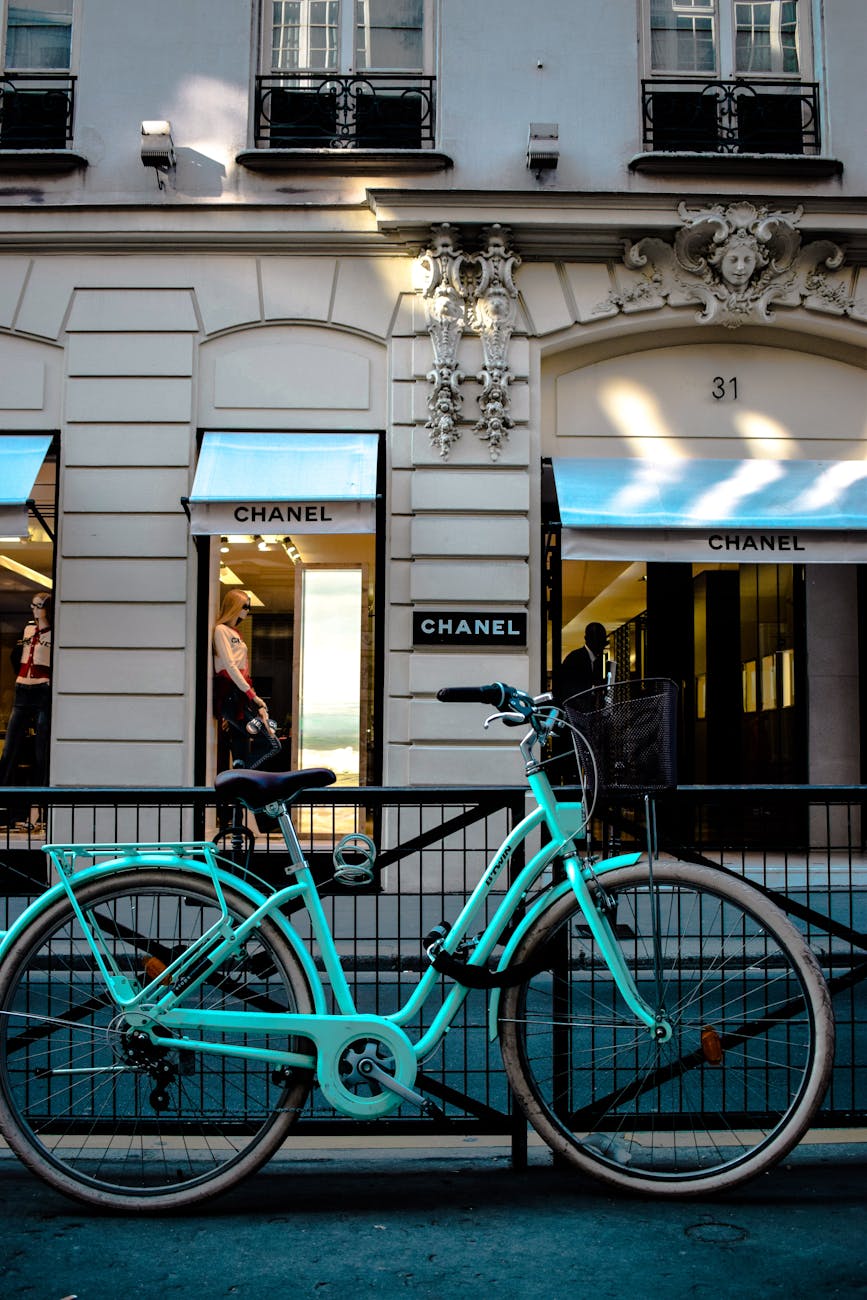
Nowhere does ‘love means love’ ring truer than in Paris, the city of love and the capital of the first (modern) country to legalise same-sex relationships.
While homosexuality wasn’t decriminalised until 1967 in the UK, and even later still in the US (2003), in France, homosexuality was decriminalised approximately two centuries before, in 1791 at the end of the French revolution.
The Revolution of Love
With an amendment to the penal code, a ‘crowd of imaginary crimes’ including sodomy were abolished.
‘Private acts by private individuals are not a matter for state intervention’, the French authorities said, thus inspiring the first wave of the decriminalisation of homosexuality in Western Europe.
With its open mindedness triggered by the French Revolution, a time of political upheaval, from the late 18th century, Paris became the place to be for creatives. Queer writers in particular, including the likes of Oscar Wilde and James Baldwin no less, flocked in their droves to the French capital.
Photo by Chris Karidis on Unsplash Not only did Paris provide queer people with a place where they could live openly, but it also provided everyone, no matter their sexual orientation, with a place where they were granted permission to just… exist.
Pursuing goals because, ‘#productivity’, too many of us, in the modern Western society within which we live, forget that the prerequisite to doing is being.
Idyllic for writers, with cafes on every corner, Paris however, with its slow way of living, reminds us of that, and they even have a word for it; ‘Flaneuring.’ The art of wandering around without intention or direction.
The Parisian life is good because in it, life can just be life. Slow and intentional.
Photo by Alice Kotlyarenko on Unsplash Someone else who moved to Paris as the French Revolution drew to a close was the trailblazing American bookseller and publisher, Sylvia Beach.
Beach exchanged the noise of America for the calm ease of Paris at the age of 30. Once there, she set up the independent bookshop, ‘Shakespeare and Company’, in 1919 with her partner, Adrienne Monnier.
A ‘sanctuary for progressive writers’ and a ‘hub for innovative publishing’, Shakespeare and Co was the first combined English-language bookshop in Paris. Also a ‘lending library’, it gave cash-strapped readers in post-World War I Paris unprecedented access to Anglo-American literature.
With an ethos very much centered on literature for literatures sake, Beach wasn’t in the business to make money as much as she was in it to make a difference.
It’s why Beach would encourage visitors to browse and read books in her store for hours without making them feel under any obligation to buy. Or leave. Beach also regularly offered writers a bed for the night under a ‘tumbleweed’ scheme, something which many established writers and aspiring wordsmiths alike took her up on.
An estimated 30–40,000 people (and counting, it is still running today) have slept in Shakespeare and Co as part of the scheme…
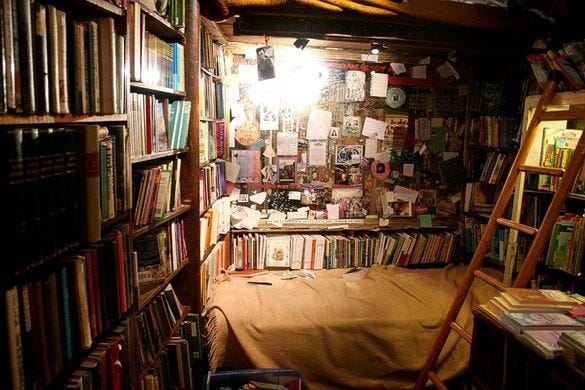
https://theubsreviewofbooks.wordpress.com/2016/09/08/tumbleweeding-at-shakespeare-co/ As Edwina Hart, travel writer and former ‘tumbleweed’ wrote in this blog post:
My fellow “tumbles” were like characters from a novel; a mix of Oxbridge undergrads, artists, poets, and bohemians — united by a love of literature. After the shop opened at 9 am, we would meander the backstreets of the quarter and pause at a local tabac for an espresso served at the bar. Following in the footsteps of Hemingway, we frequented his old haunts and continued towards the “wonderful, narrow street market” of rue Mouffetard. Here we would use the jangling purse of coins donated in the bookstore wishing well (Sign: “Feed the starving writers”). We’d buy a baguette on rue Monge and, if the donations were generous that week, some gooey Camembert.
While the Tumbleweed scheme still exists today, it is in a different location, in a later ‘Shakespeare and Company’ that was set up by George Whitman.
Whitman opened what was originally called Le Mistral, dubbed by Slyvia Beach as the ‘spiritual successor’ to Shakespeare and Company in 1951. In 1964, two years after Sylvia’s death, Whitman changed the store’s name to Shakespeare and Company in Beach’s honour.
The store is, as of January 2025, run by George’s daughter, Sylvia (named after Sylvia Beach), and follows the same ethos now as it did then.
In trying to uphold Beach’s legacy, smaller publishes are prominently displayed on their shelves, with the aim to ‘offer a diversity of contemporary voices and subject matters’, the latter point being something that Beach, who helped shape the literary landscape of her age, prided herself on…
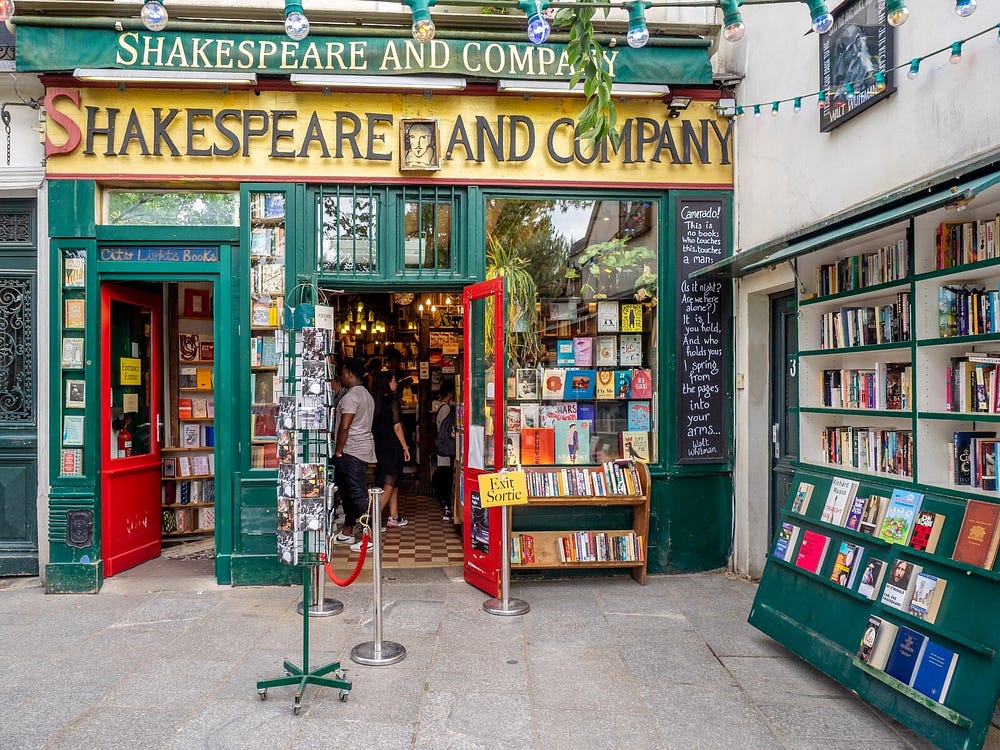
https://mazzottibooks.co.uk/blog/2020/10/29/a-reflection-on-my-time-at-shakespeare-amp-company-in-paris Shakespeare and Company (1919) was the first place of publication for some of the most important poets, novelists, and critics in the early decades of the 20th Century, including, most famously, Irish writer James Joyce who had been trying (unsuccessfully) to publish ‘Ulysses’ for several years.
After meeting Joyce in 1920 when nobody would publish his novel because it was deemed obscene, ‘far too hot to handle’, Beach decided that Shakespeare and Co. would put the book out, making it, for many years, the only place on the planet where you could get a copy.
‘It sounds to me like the ravings of a disordered mind — I can’t see why anyone would want to publish it.’
As a lesbian, Sylvia Beach knew all too well the tools that the people in power will use to stay in power.
The authorities hated Ulysses because they feared it. It’s why Margaret Anderson and Jane Heap, the editors of the Little Review (1918) were summoned to court owing to them having ‘violated New York’s anti-obscenity law’ when they printed a mere excerpt of the book.
It’s also why, in 1931, the BBC prohibited its radio programmes from so much as even mentioning the title of Joyce’s novel on air.

https://historical.ha.com/itm/books/literature-1900-up/james-joyce-ulysses-paris-shakespeare-and-company-1922-first-edition-number-513-of-750-numbered-copies/a/6085-36171.s In 1921, John Sumner, the man who led the Little Review prosecution, argued that “radical feminists” were “writing insidious books on the freedom of the modern woman, and advocating still greater sex freedom” (contraception, perhaps, or information about contraception, both of which were illegal). Censors like Sumner assumed that Ulysses’ characters would lead women down a path of ‘ever-expanding permission ending in broken families and a ruined nation.’
Reviewers saw Ulysses not just as obscene but as “completely anarchic”.
Exploring sexual pleasure outside marriage could lead to questions about the wisdom of marriage and monogamy itself, authorities feared, which opened the door to questioning all unexamined pieties, including nationalism, capitalism, and religion.
Alas, ‘If a man holds up a mirror to your nature and shows you that it needs washing, it is no use breaking the mirror. Go for soap and water.’
George Bernard Shaw.Unafraid to stand for what was right, and fearless of the repercussions that might arise in doing so, we have Beach and her literary comrades of the twentieth century to thank for our freedom in the twenty-first.
Paris, and the modernism that it, in many ways, birthed, is the mirror, as held up by Sylvia Beach, and Margaret Anderson, and George Whitman, and Jane Heap, and all the other trailblazers of the twentieth century, through which we are all reflected.
Because of them, we don’t have to live in fear that one day we might produce the ‘wrong’ kind of art and end up in jail because of it. We don’t have our self-expression diluted, our words banned, our voices stifled.
Because of them, we can write about masturbation and sex and abortion, and secularisation and white supremacy and capitalism, all the things that were deemed too close to home, ‘off limits’, a century ago.
Because of them, we are free.

https://paulcombs.medium.com/meet-sylvia-beach-the-one-true-patron-saint-of-booksellers-154d90eae663 -
The Impact Of Capitalism: Money Makes The World Go Round
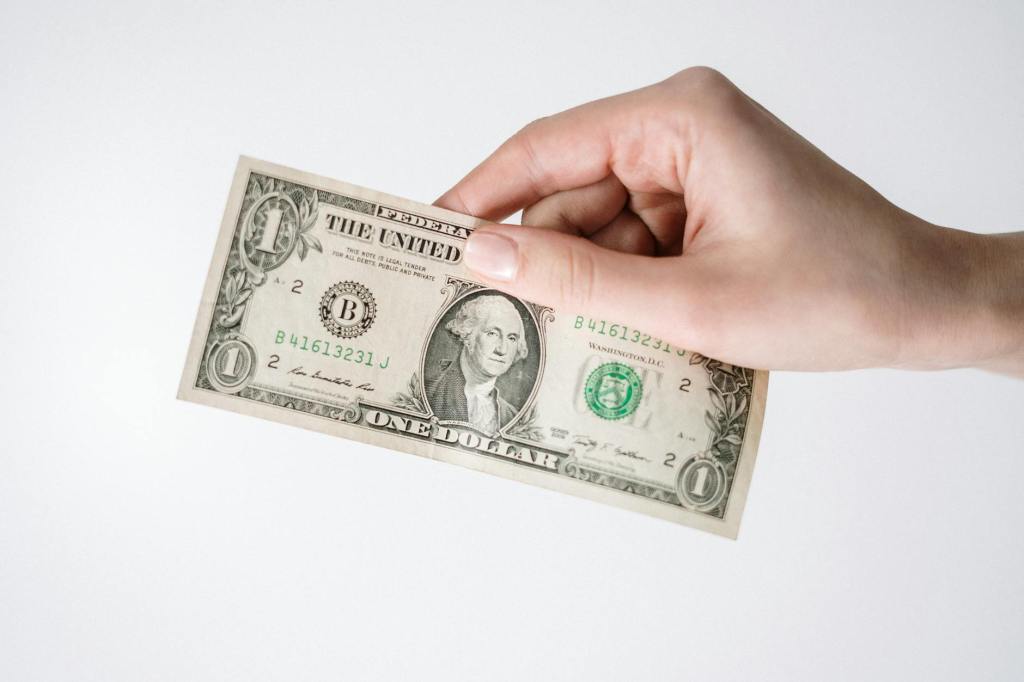
Sitting in the front row in a London theatre turned Berlin nightclub, performers in touching distance as we sip from a bottle of Moet & Chandon, ‘Money Money’ (Joel Grey and Liza Minnelli) has never felt more apt.
If you happen to be rich
And you feel like a night’s entertainment
You can pay for a gay escapade.Money makes the world go round indeed…
Wealth inequality in society is stark.
It’s nothing new, yet with everything that we do and everything that we are, we are reminded of it and struck by the fact that it’s 2025 and we are still no closer to bridging the gap. In fact, if anything, each passing day is, in fact, widening the rift that sees us drifting further and further apart from each other, all because we belong to a different social class.
Alas, despite all the protests and calls for change, when the very foundations of capitalism are dependent on the people at the top retaining control over all the resources and means of production, while the people at the bottom are forced to sell their labour to ensure their survival, we are still yet to experience the changed society that the puppet masters promised us.
How can one escape something when it is what they have been told is their only way to escape something else?…
Photo by Mike Erskine on Unsplash Working every waking hour, when you are not fortunate enough to have been born into wealth, you end up spending the entirety of your life wishing that you had been, (self-pitying), and then trying to be, (to no avail).
The pursuit to have even a fraction of the wealth that they have is never-ending, and always, every time, to no avail…
But still, we try, working a dead-end job just to pay the bills that will go straight into the pocket of a smug-faced millionaire.
Your struggles might not pay your bills (who cares?) but at least they’ll pay mine.
While the working classes lay awake at night filled with worry about how they will pay their bills, the middle and upper classes have no such worries. Instead, they spend their nights (and days) deciding what lavish thing to spend their money on next.
It is this that I find the most heartbreaking about wealth inequality and it’s why, upon sitting in the theatre two weekends ago watching Cabaret with my fiancé, I couldn’t help but feel angered.
Money cannot and does not buy happiness, but it can and does buy opportunities that bring one happiness…
The trip for us was a once-in-a-lifetime type of moment, something special, a memory that we will hold onto for it is not our everyday. Yet for other people, like the man seated in the box (the most prestigious and expensive seat in the theatre) who fell asleep several times throughout, and the woman seated next to him who had the biggest, smuggest grin on her face as they sang the chorus of Money Money, ‘money money money money money money money money money money money money money money money money money money money money’, this is their everyday… Date nights of theatre trips and all-inclusive holidays to our supermarket pizzas in front of the telly, the question lingering in the back of our minds is one of…
Why is it so unfair?
Why is the quality of our life based on, not even something earned like hard work, but something as coincidental as the flip of a coin?
When what you’re born into determines the rest of your life…
Social mobility does exist, but it’s undoubtedly rare when the lifestyle of the middle class is a cult within which we don’t belong. Life’s greatest tragedy…
It is life’s greatest tragedy that the blueprint of our lives has already been determined when we are but a cell in our mother’s womb.
It is a tragedy that we are all born but not all of us live because we can’t afford the privilege of it.
There are people who will go on tourist trips to Mars one day, rockets becoming to them what planes are to us, and people who will sit in the back of a driverless car, and, who knows, maybe one day there will be people paying in life to be preserved in death.
There is so much happening in the world.
Photo by Moritz Kindler on Unsplash We hear it on the news where segments are devoted to innovation and technological advances, and buzzwords are thrown around concerning robots and automation and a ‘digital afterlife.’ What we don’t hear on the news, however, is just how inaccessible this all is unless, of course, you’re rich…
It’s not just the sci-fi-like technological things that we miss out on, either, but also the everyday. The things that differentiate living from surviving.
There are shows being performed right now, concert halls and auditoriums, and stadiums being filled with people who have the holy grail, money, to be able to see them, meanwhile, you’re at home, looking through archives on BBC iPlayer of old Glastonbury clips because you know that you will never be able to afford tickets to the real thing. Or plane tickets. You’ll never be able to afford plane tickets, either…
Despite some people having whole photo albums filled with snaps from holiday after holiday, the closest that you will ever get to venturing outside of the UK is when you pass the displays outside the travel agents. But why? Why is our ability to explore the world, our home, conditional based on how much money we have?
Our right to travel should be a birthright.
In the same way that you wouldn’t take away someone’s keys and then make them say thank you when you give them back, because what’s rightfully ours is always ours, travelling from one place to another is not something that we must feel grateful for. It is, or at least, it should be, a given.
Photo by Ben White on Unsplash We shouldn’t be forced to spend our whole lives working in a job that we hate only to get to the end having neglected to do what we really wanted to do. Yet most people have no choice but to do this, for survival trumps everything. And so, with limited money to spend, if it’s a choice between putting food on the table or buying a table for you to turn your art hobby into a career, the former will win every time (a very specific example, but the reason why fewer than one in ten arts workers in the UK have working-class roots).
Imagine not having such limited resources, though… The world would be yours. The opportunities endless.
In other words, imagine being a man.
Deep pockets,
shallow heart.Big ego,
tiny soul.All human,
no humanity.Oh, to be rich.







 Portfolio of Hope